Best Baseball Radar Guns 2026: 9 Speed Guns for Pitching and Exit Velo, From $65 to $600
The best baseball radar gun for most families and coaches is the Pocket Radar Smart Coach (~$399): within 1 mph, pocket size, and it records video with the speed on the clip. We ranked 9 live speed guns across every price tier, from a $65 backyard unit and the $150 Bushnell Velocity to the $600 Bushnell MACH2, with a spec table and a plain-English guide to accuracy.
In this guide · 13 sections
- Helmet headset
- At a glance
- Baseball radar gun comparison: every spec side by side
- Which radar gun should you buy? Pick by who you are
- What makes a baseball radar gun accurate?
- Doppler vs. cosine error: why your radar reads low
- How far away can a radar gun read a pitch?
- Tripod vs. handheld: which setup do you need?
- Radar gun app features: what is worth paying for?
- Cheap baseball radar guns: what $65 to $120 buys
- What the numbers mean once you have a radar
- Also worth a look
- FAQ
Quick picks
Our top recommendations, full reviews below.
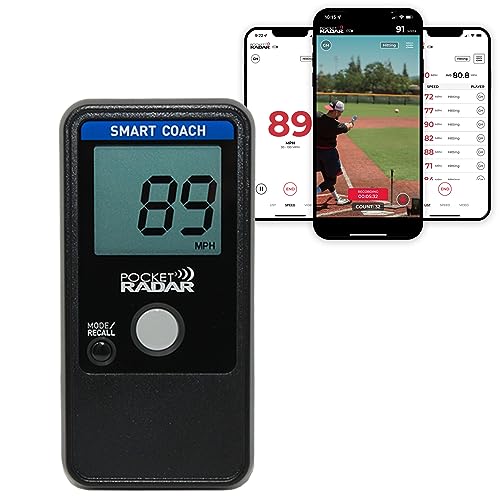
Best overall: pro-trusted accuracy that records the rep and the number together
~$399 price and availability on Amazon
View on Amazon →Key takeaways
- Best overall: Pocket Radar Smart Coach (~$399). Published +/- 1 mph accuracy, 25 to 130 mph, a 120-foot range, and an app that stamps the speed onto video of the pitch.
- Best simple gun: Pocket Radar Ball Coach (~$299). Same radar, same accuracy claim, no app. Point, read, done. The team-bag standard.
- Best budget real radar: Bushnell Velocity (~$150). A true Doppler pistol gun rated +/- 1 mph from about 90 feet. Under $150, you are in the fun tier.
- Accuracy stops improving around $150 to $300. Past that you pay for range, pickup speed, logging and video, not a better number.
- Where you stand matters more than which gun you buy. Stand 20 degrees off the ball's path and any radar reads about 6 percent low. Get directly behind the catcher, pitcher or net.
- Handheld or tripod? Handheld for a coach reading bullpens; tripod or hands-free for a player training alone into a net.
The best baseball radar gun for most buyers is the Pocket Radar Smart Coach (about $399). It reads pitch speed and exit velocity within a published 1 mph, fits in a pocket, and pairs with an app that records video with the speed burned onto the clip. If you only want a trustworthy number, the Pocket Radar Ball Coach (about $299) is the same radar without the app. If the budget is $150, the Bushnell Velocity is the cheapest real speed gun from an established brand. Below $120, units like the NET PLAYZ and PLAYAPUT are fun and roughly right, not tools you should make training decisions with.
We checked all nine listings live on Amazon on September 29, 2026, and pulled specs from each maker's published numbers. This page covers every format (pocket, full-size pistol grip, hands-free tripod) and every tier. It includes a side-by-side spec table and a buying guide covering the things that actually decide accuracy: angle, range, Doppler versus cosine error, and how you mount the gun. If you already know you want a Pocket Radar, our best Pocket Radar guide goes deeper on those models and their kits.
At a glance
| Pick | Best for | Price* | ||
|---|---|---|---|---|
| Pocket Radar Smart Coach (App-Connected, Records Video + Velocity) | Best overall: pro-trusted accuracy that records the rep and the number together | ~$399 | View → |
 | Pocket Radar Ball Coach | Best simple gun: point, trigger, read, and any coach can use it cold | ~$299 | View → |
 | TAG ONE Sports Radar (Rechargeable, App Integration) | Best rechargeable app radar: USB-C charging, a card-size body and phone logging | ~$300 | View → |
 | Bushnell MACH2 Smart Radar Gun (Baseball & Softball) | Best full-size smart gun: pistol grip, release and exit velo on one screen | ~$600 | View → |
 | Bushnell Velocity Speed Gun | Best budget real radar: the classic pistol-grip speed gun at half the pocket price | ~$150 | View → |
 | NET PLAYZ Velocity X Baseball Speed Radar (Narrow Beam) | Best under $120: a pitcher-specific hands-free unit with a narrow beam and big LCD | ~$114 | View → |
 | PLAYAPUT Baseball Radar Gun with Tripod (LED + LCD Display) | Best budget station: tripod included, big LED readout for the backyard | ~$80 | View → |
 | NET PLAYZ Multi-Sports Speed Radar (Hands-Free) | Cheapest gift pick: a hands-free unit that makes throwing a game | ~$65 | View → |
 | Swing Speed Radar (Doppler Bat and Swing Speed) | Best for hitters: measures bat speed, not ball speed | ~$135 | View → |
*Prices at time of writing, they move; check the listing.
Pocket Radar Smart Coach (App-Connected, Records Video + Velocity)
~$399
The Smart Coach is the radar the youth and amateur game has standardized on, and it wins here because it handles both halves of the job. Pocket Radar publishes a 25 to 130 mph range, +/- 1 mph accuracy and a range of about 120 feet. That is the same accuracy claim you get from guns that cost twice as much. Then it goes further. Over Bluetooth it talks to the Pocket Radar app, which embeds the speed in video of the pitch or swing, keeps a history you can export, calls speeds out loud, and lets you trigger the radar from your phone.
It runs on two AAA batteries, has a hands-free Constant-On mode for tripod use, and remembers recent readings on the device, so it still works as a plain radar when no phone is around. The $100 over the Ball Coach only pays off if someone actually opens the app. For the head-to-head, see Smart Coach vs. Ball Coach.
- Published +/- 1 mph accuracy, 25 to 130 mph, about 120 ft range
- Speed embedded in video through the Pocket Radar app
- Hands-free Constant-On mode for tripod or fence use
- Pocket size; works without a phone too
- $100 more than the Ball Coach for the app features
- App video drains a phone battery on long tournament days
Pocket Radar Ball Coach
~$299
The Ball Coach is the radar that lives in the most team bags. Pocket Radar rates it the same as the Smart Coach: 25 to 130 mph, +/- 1 mph, about 120 feet. It has the same Constant-On hands-free mode and a memory of the previous 25 readings. What it leaves out is Bluetooth. The Amazon listing says plainly that it is not compatible with the Pocket Radar app, so there is no video, no history on the phone and no remote control.
For shared team gear, that is a feature. Five coaches can pick it up, trigger it and read the screen with nothing to pair and nothing to update. If you only need to know whether a kid is sitting 58 or 62 today, this is the cleanest $299 in the category.
- Same published accuracy and range as the Smart Coach
- Nothing to pair: any coach gets a number in seconds
- Constant-On mode plus 25-reading memory
- Two AAA batteries, fits a back pocket
- Not app compatible, so no video or history, ever
- Someone has to read the screen each pitch unless it is mounted
TAG ONE Sports Radar (Rechargeable, App Integration)
~$300
The TAG ONE is the newest serious name in the category and the main alternative families cross-shop against Pocket Radar. The maker lists +/- 1 mph accuracy, a 20 to 225 mph range, up to about 130 feet of reach, and an internal USB-C rechargeable battery rated around 6 hours. It is roughly credit-card sized and pairs with the TAG Sports app. The maker says the app logs readings, builds player profiles and can capture video.
At about $300 it costs the same as the Ball Coach, and you get app features and a rechargeable battery for it. The honest trade is track record: Pocket Radar has been in dugouts for more than a decade, and the TAG ONE is newer. There is also a TAG ONE bundle with a full-size telescoping tripod (about $340) if you are training solo.
- Rechargeable USB-C battery, rated about 6 hours
- App logging and player profiles at a Ball Coach price
- Very small; lives in a pocket or bat bag
- Wide speed range covers baseball, softball and other sports
- Shorter track record than Pocket Radar
- Maker specs not yet widely verified by independent reviewers
Bushnell MACH2 Smart Radar Gun (Baseball & Softball)
~$600
The MACH2 is Bushnell's modern full-size radar, built specifically for baseball and softball. Bushnell lists +/- 1 mph accuracy across 20 to 125 mph, a reading distance of about 130 feet, and a battery rated around 14 hours. The large display can show release velocity and exit velocity together. A free app pairs over Bluetooth for remote triggering, a full-screen readout, audible speed calls and player profiles. At time of writing, extras such as video with a speed overlay, pitch tagging and career tracking are paid upgrades inside the app.
The full-size pistol grip is the whole point. It is easier to hold steady and aim from behind a backstop for a two-hour bullpen, and a tryout station reads more official with a real gun than with a phone-sized box. At about $600 it is a program purchase. One family tracking one pitcher gets more from a Smart Coach for less money.
- Full-size grip that aims steadily from behind the backstop
- Release and exit velocity together on one display
- About 130 ft reading distance, rated around 14 hr battery
- Free app for remote trigger and audible speed calls
- Most expensive gun on this list
- Video overlay and advanced tracking are paid app upgrades
- Bulky next to a pocket unit
Bushnell Velocity Speed Gun
~$150
The Velocity is the speed gun a generation of coaches learned on, and it is still the cheapest way to own a real Doppler radar from an established brand. Bushnell rates it at 10 to 110 mph for ball sports with +/- 1 mph accuracy. It reads a baseball from up to about 90 feet and runs on two C batteries. Squeeze the trigger, read the big LCD, repeat.
Its 90-foot baseball range is shorter than the 120 to 130 feet of the newer units, so stand closer, directly behind the catcher. It has no memory worth mentioning and no app. For a parent who wants the truth about a kid's velocity, or a budget program outfitting its first bullpen, it is still the default answer.
- Real Doppler radar rated +/- 1 mph
- Cheapest gun here from an established brand
- Dead simple trigger and large readable display
- Long track record in team bags
- Shorter range (about 90 ft for a baseball)
- No app, logging or video
- Runs on C batteries; bulky pistol grip
NET PLAYZ Velocity X Baseball Speed Radar (Narrow Beam)
~$114
The Velocity X is NET PLAYZ's step up from its famous $65 unit, and it is aimed squarely at pitchers. The maker describes a narrow, focused K/Ka-band beam meant to reject crosstalk from nearby throws. It has continuous or single-read modes, a reading recall, and a large high-contrast LCD you can read from the mound. Set it behind the catcher or net, throw, and read the number without anyone holding a gun.
The maker claims +/- 1 mph. Read any sub-$150 accuracy claim with healthy skepticism until independent owners have backed it up over a season. In a crowded cage, the narrow beam is the right design choice. As a solo bullpen station that costs less than half a Ball Coach, it is the most pitcher-focused budget unit we found live.
- Narrow beam designed to ignore throws in the next lane
- Continuous mode for hands-free solo sessions
- Large LCD readable from the mound
- Under half the price of the pocket tier
- Budget maker's accuracy claim, not independently proven
- No app or video
- Short manufacturer warranty compared with the big brands
PLAYAPUT Baseball Radar Gun with Tripod (LED + LCD Display)
~$80
The PLAYAPUT's selling point is the setup: it ships with a tripod and puts the reading on a large LED plus an LCD. You stand it behind a net, throw, and see the number from the mound. For a kid who will throw all afternoon as long as the number keeps lighting up, that hands-free station is exactly right.
Treat it as budget tier. Sub-$100 radars read best straight on at short range, and their session-to-session wobble is wider than the Pocket Radar tier. As a backyard motivator it is great. As the basis for a velocity program it is not.
- Tripod included: real hands-free setup
- Big LED readout visible from the mound
- Cheap enough for backyard duty
- Budget-tier consistency
- Short effective range; misses some off-line throws
NET PLAYZ Multi-Sports Speed Radar (Hands-Free)
~$65
The original NET PLAYZ is the entry ticket. It is a $65 hands-free sensor you set behind the target, and it reads baseball, softball, soccer and most anything else the household throws or kicks at it. As a birthday gift or a first taste of "how fast was that," it does the job.
Its job is fun, not measurement. Expect wider error, short range and the occasional missed read. When the numbers start to matter (velocity goals, showcase prep, lesson feedback), step up to the Bushnell Velocity or the Pocket Radar tier and keep this one for the backyard.
- Cheapest verified unit on the list
- Hands-free: set it and throw
- Multi-sport for the whole household
- Great gift
- Fun-tier accuracy; not for training decisions
- Short range, occasional missed reads
Swing Speed Radar (Doppler Bat and Swing Speed)
~$135
This one reads a different number. Every other unit here reads the ball. The Swing Speed Radar sits on the ground near the hitter and reads the bat: swing speed through the zone, which is the input that produces exit velocity. It has been a golf and baseball training tool for many years, and it needs no pitcher, no net contact and no ball, so dry swings in the garage count.
Pair it with any ball radar above and you get both halves of the hitting equation: how fast the bat moves and how hard the ball leaves. It will not read a pitch, so it complements the list rather than replacing a radar gun.
- Reads bat speed directly, no ball needed
- Works indoors on dry swings
- Long track record as a training tool
- Does not read pitch speed or exit velocity
- A specialty tool, not your only radar
Baseball radar gun comparison: every spec side by side
Every gun from the Bushnell Velocity up carries a published +/- 1 mph accuracy claim, so the real differences are range, format, app features and power. Specs below are each maker's published numbers at time of writing. Prices are rounded from the live Amazon listing and move often.
| Radar | Price | Format | Speed range | Stated accuracy | Reach | App / video | Power |
|---|---|---|---|---|---|---|---|
| Pocket Radar Smart Coach | ~$399 | Pocket, handheld or tripod | 25 to 130 mph | +/- 1 mph | ~120 ft | Yes: speed in video, export | 2x AAA |
| Pocket Radar Ball Coach | ~$299 | Pocket, handheld or tripod | 25 to 130 mph | +/- 1 mph | ~120 ft | No | 2x AAA |
| TAG ONE | ~$300 | Card-size, handheld or tripod | 20 to 225 mph | +/- 1 mph | ~130 ft | Yes: logging, profiles, video capture | USB-C rechargeable, ~6 hr |
| Bushnell MACH2 | ~$600 | Full-size pistol grip | 20 to 125 mph | +/- 1 mph | ~130 ft | Free app; video overlay is a paid upgrade | Rated ~14 hr |
| Bushnell Velocity | ~$150 | Full-size pistol grip | 10 to 110 mph | +/- 1 mph | ~90 ft (baseball) | No | 2x C |
| NET PLAYZ Velocity X | ~$114 | Hands-free station | Pitching speeds | +/- 1 mph (maker claim) | Short, behind the target | No | Batteries |
| PLAYAPUT with tripod | ~$80 | Hands-free tripod station | Pitching speeds | Budget tier | Short | No | Batteries |
| NET PLAYZ hands-free | ~$65 | Hands-free station | Multi-sport | Budget tier | Short | No | Batteries |
| Swing Speed Radar | ~$135 | Ground unit by the hitter | Bat speed | n/a (reads the bat) | A few feet | No | Batteries |
If you only read one row, read the top one. If you only have $150, read the Velocity row. Everything under that line is a fun tier, and you should buy it knowing that.
Which radar gun should you buy? Pick by who you are
Match the gun to the buyer: parents tracking one pitcher want the Smart Coach, coaches sharing a gun want the Ball Coach or a Bushnell, programs want the MACH2, and backyard buyers should stay under $120.
| You are | Buy | Price | Why |
|---|---|---|---|
| A parent tracking one pitcher's development | Pocket Radar Smart Coach | ~$399 | Video with the speed on it, plus history |
| A coach who wants a number, zero fuss | Pocket Radar Ball Coach | ~$299 | Anyone can use it, nothing to pair |
| A family that wants app logging and hates batteries | TAG ONE | ~$300 | Rechargeable, app-connected |
| A budget parent or first-time program | Bushnell Velocity | ~$150 | Cheapest real radar from a known brand |
| A high-school or travel program | Bushnell MACH2 | ~$600 | Full-size, release plus exit velo, all-day battery |
| A pitcher training alone into a net | NET PLAYZ Velocity X or a tripod-mounted Smart Coach | ~$114 or ~$434 kit | Hands-free readings every rep |
| A hitter measuring the swing itself | Swing Speed Radar | ~$135 | Bat speed on dry swings |
| A gift buyer or backyard family | NET PLAYZ or PLAYAPUT | ~$65 to ~$80 | Fun and roughly right |
Spend up only for a feature you will use every week: video for a developing pitcher, full-size ergonomics for a program, range for gunning from deep behind a backstop. Otherwise the cheaper serious pick reads the same pitch.
What makes a baseball radar gun accurate?
Three things decide accuracy: the quality of the sensor and its filtering, your angle to the ball's path, and your distance from it. Price mostly buys the first one, and only up to a point. Every gun on this list from the $150 Bushnell up publishes a +/- 1 mph accuracy claim, and in practice readings from those units agree closely when each one is set up correctly. The fun tier under $120 cuts cost in filtering and beam quality. That shows up as more wobble between sessions, missed reads on small youth baseballs, and trouble with throws that are not coming straight at the sensor.
The single biggest factor, though, is free: where you stand. That is the cosine effect, explained next. Our dedicated explainer, how accurate are pocket radar guns, has the full tier-by-tier accuracy chart and the setup habits that get scout-quality numbers from a $300 unit.
Doppler vs. cosine error: why your radar reads low
Every sports radar is a Doppler radar. It measures how much the ball's motion shifts the frequency of the signal bouncing back, and it only sees the part of the ball's speed coming straight at (or straight away from) the gun. Stand off to the side of the flight path and the gun measures the true speed multiplied by the cosine of your angle. Engineers call the shortfall cosine error, and it always reads low, never high.
| Angle off the ball's path | Reading on a true 70 mph pitch | Reading on a true 85 mph pitch |
|---|---|---|
| 0 degrees (directly behind) | 70 mph | 85 mph |
| 10 degrees | about 69 mph | about 84 mph |
| 20 degrees | about 66 mph | about 80 mph |
| 30 degrees | about 61 mph | about 74 mph |
That table explains most "the showcase gun read 4 higher" arguments. Showcase guns sit dead behind the plate. Parents hold theirs from beside the backstop. Put the gun on the line, directly behind the catcher or the pitcher at roughly ball height, and a $150 Bushnell and a $399 Pocket Radar will agree within a mile per hour or two. The second source of disagreement is release speed versus plate speed. A pitch loses several mph between the hand and the plate, and most consumer radars report the peak (release) speed.
How far away can a radar gun read a pitch?
Pocket and full-size units in the serious tier publish reading distances of about 90 to 130 feet: roughly 90 feet for the Bushnell Velocity, about 120 feet for both Pocket Radars, and about 130 feet for the TAG ONE and MACH2. That is more than enough from behind a catcher on a 46-foot or 60-foot 6-inch mound. Budget hands-free units want to sit a few feet behind the target and read the ball as it arrives.
Range matters in two situations. The first is gunning from deep behind a backstop or from the stands, which is where scout-grade guns such as the Stalker line earn their price. (We did not find a live Stalker listing on Amazon at our September check, which is why none appears in our picks.) The second is exit velocity on long hits, where the ball is moving away from you and the reading has to happen quickly. For almost every family and team, 90 to 130 feet is plenty.
Tripod vs. handheld: which setup do you need?
Handheld works when a coach or parent is standing behind the catcher anyway; a tripod or hands-free station works when a player is training alone or when you want every pitch read at the same angle. A tripod also cures the most common accuracy problem, because it puts the radar on the pitch line at pitch height every single session. Consistent setup is what makes week-over-week trends real.
- Handheld: Ball Coach, Smart Coach or TAG ONE in a pocket, or a Bushnell pistol grip for team duty. Best for coaches reading bullpens and games.
- Tripod-mounted pocket radar: the Pocket Radars and the TAG ONE have hands-free continuous modes. Pocket Radar sells a Smart Coach plus tripod mount bundle (about $434), and TAG sells a TAG ONE plus telescoping tripod bundle (about $340).
- Self-contained stations: the Velocity X and PLAYAPUT sit behind the target with a big display you can read from the mound.
Building out a solo throwing setup? Pair the radar with a net and a mound from our backyard training setup guide and portable pitching mound picks.
Radar gun app features: what is worth paying for?
The feature worth paying for is speed embedded in video; logging is nice; everything else is a convenience. A clip of the delivery with the number on it tells a pitcher and a coach far more than a number written on a hand. The Smart Coach does this through the Pocket Radar app, the TAG ONE's app lists video capture, and on the MACH2 video overlay is a paid in-app upgrade at time of writing. The Ball Coach and Bushnell Velocity have no app at all.
One warning: a "radar gun app" on its own is not a radar. Phone apps estimate speed from video frames and a distance you type in, and they drift by several mph. We break that down in radar gun app vs. a real radar gun. The apps that come with real radars are a different thing. They receive a measured number over Bluetooth, and that is why they can be trusted.
Cheap baseball radar guns: what $65 to $120 buys
A $65 to $120 radar gets you a fun, roughly right number, not a measurement you should base a training plan on. Budget units typically wobble a couple of mph between sessions and need the ball coming almost straight at them. They also miss some reads on small, fast youth baseballs. That wobble is bigger than the month-over-month gain a real training block produces, so a cheap gun cannot see the progress you are training for.
That does not make them a waste. A $65 hands-free unit that gets a 9-year-old excited to throw is money well spent, and the Velocity X is a real step up for a solo pitcher. The moment a number will drive a decision, such as a velocity program, a showcase or pulling a tired arm, move up to the Bushnell Velocity or the Pocket Radar tier.
What the numbers mean once you have a radar
Compare readings to typical ranges for the age and the mound distance, and watch the trend, not the single best pitch. Our pitching speed by age chart gives typical and fast ranges from 8U to MLB, for baseball and fastpitch. A radar is also an arm-care tool: a pitcher whose velocity sags several mph inside an outing is telling you he is tired, and that is exactly the kind of drop the pitch count rules exist to prevent.
Coaches running a radar in games usually have a phone in hand for the lineup, the scorebook and the pitch calls too. The free MAVTRAX app sends the called pitch to a $13 speaker inside the catcher's helmet and runs on the same phone as the Pocket Radar app without conflict. More on that in the free pitch-calling app guide.
Also worth a look
FAQ
What is the best baseball radar gun?
The Pocket Radar Smart Coach (~$399) is the best baseball radar gun for most buyers: published +/- 1 mph accuracy, pocket size, a 120-foot range, and an app that embeds the speed in video. The Pocket Radar Ball Coach (~$299) is the best no-app pick, the Bushnell Velocity (~$150) is the best budget real radar, and the Bushnell MACH2 (~$600) is the best full-size gun for programs.
What is the best cheap radar gun for baseball?
The Bushnell Velocity at about $150 is the cheapest real Doppler radar from an established brand, rated +/- 1 mph from up to about 90 feet. Under that, the NET PLAYZ Velocity X (~$114) is the most pitcher-focused budget unit, and the NET PLAYZ (~$65) and PLAYAPUT (~$80) are fun backyard units with wider error.
How accurate are baseball speed guns?
Quality guns from Pocket Radar, Bushnell and TAG publish +/- 1 mph accuracy, and they agree closely when aimed straight down the ball's path. Budget units under $120 commonly drift a couple of mph between sessions. At any price, standing 20 degrees off the line reads about 6 percent low.
Where should you stand with a radar gun for pitching?
Directly behind the catcher or directly behind the pitcher, in line with the pitch and at roughly ball height. Any angle off that line makes the gun read low (cosine error). For exit velocity, stand behind the hitter or behind the net in the direction of the hit.
Do radar guns read release speed or plate speed?
Most consumer radars, including Pocket Radar, report the peak speed, which is at or near release. A pitch slows by several mph on the way to the plate, so a gun that reports plate speed will read lower for the same pitch.
Can a radar gun measure exit velocity?
Yes. The Pocket Radars, TAG ONE and Bushnell guns all read exit velocity when aimed along the ball's flight, from behind the hitter or behind the net. The Bushnell MACH2 can show release and exit velocity together. To measure the bat itself, use a Swing Speed Radar (~$135).
Do radar guns work for fastpitch softball?
Yes. Every radar here reads well below fastpitch speeds (Pocket Radar starts at 25 mph, Bushnell at 10 to 20 mph). The same rules apply: stand directly behind the catcher or pitcher on the pitch line. Fastpitch distances are shorter, so a gun set close behind the catcher is well inside every unit's range.
Is a pocket radar as good as a full-size radar gun?
For accuracy, yes: the Pocket Radars carry the same +/- 1 mph claim as full-size guns. Full-size guns like the MACH2 win on grip, all-day battery and aiming steadily from behind a backstop. Scout-grade guns add longer range and faster pickup, not a fundamentally better number.
We're the team behind MAVTRAX, a free pitch-calling app. This is a research guide: picks are chosen on manufacturer specs, league rules, build quality and real-world price, checked against live listings, not on who pays the highest commission. We haven't hands-on tested every product. Full criteria on how we pick.