Pocket Radar Smart Coach vs. Ball Coach: Same Radar, So Which Should You Buy?
Verdict: buy the Smart Coach (~$399) if the radar is for one player's development, and the Ball Coach (~$299) if it lives in a team bag. Both use the same radar with the same published +/- 1 mph accuracy, 25 to 130 mph range and 120-foot reach. The extra $100 buys Bluetooth, the Pocket Radar app (speed embedded in video, history, remote display) and compatibility with the Smart Display scoreboard. Here is the decision table and exactly who should pay for it.
In this guide · 13 sections
- Helmet headset
- At a glance
- Ball Coach vs. Smart Coach: the decision table
- Smart Coach vs. Ball Coach: full spec comparison
- What is the difference between the Pocket Radar Ball Coach and Smart Coach?
- When the Smart Coach is worth the extra $100
- When the Ball Coach is the smarter buy
- What a complete setup really costs
- Accuracy: both are good, and both are only as good as your angle
- The two accessories that matter more than the model
- Smart Coach or Ball Coach vs. the alternatives
- Also worth a look
- FAQ
Quick picks
Our top recommendations, full reviews below.
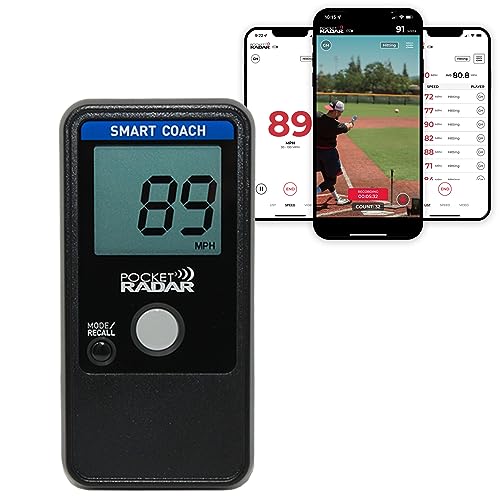
Buy this for one player's development: speed on video, session history, Smart Display ready
~$399 price and availability on Amazon
View on Amazon →Key takeaways
- Verdict: Smart Coach for one player's development, Ball Coach for a shared team gun. If you are not sure you will open the app every week, buy the Ball Coach.
- Same radar, same accuracy. Pocket Radar publishes +/- 1 mph, 25 to 130 mph and about 120 feet of range for both. A pitch reads the same on either one.
- The $100 buys three things: Bluetooth to the Pocket Radar app (speed embedded in video, history, CSV export, audio callouts, remote control), wireless readout on your phone, and compatibility with the Smart Display scoreboard.
- Both have hands-free Constant-On mode and remember the last 25 readings, both run on 2 AAA batteries, and both are the same pocket size.
- The Ball Coach can never be upgraded to the app. If there is a real chance you will want video or history later, buy the Smart Coach now instead of buying twice.
Verdict first: buy the Pocket Radar Smart Coach (about $399) if the gun is for one pitcher's or hitter's development and you will actually use the video and history. Buy the Pocket Radar Ball Coach (about $299) if it lives in a team bag, gets passed between coaches, and its only job is reading a number at the mound. The radar inside is the same. Pocket Radar publishes the same +/- 1 mph accuracy, 25 to 130 mph speed range and roughly 120-foot reach for both, and the two units are the same size and weight. The Smart Coach adds a Bluetooth link to the Pocket Radar app, which embeds each reading in video, keeps a session log and lets you read speeds on your phone. It is also the only one of the two that works with Pocket Radar's Smart Display scoreboard.
If you never open that app, the Smart Coach is a $399 Ball Coach. Below you will find the decision table that settles it for most buyers, the full spec table, where each model genuinely wins, the real cost of a complete setup, and the accessories that matter more than the model. For the rest of the field (TAG ONE, Bushnell and budget units), see our best baseball radar guns ranking.
At a glance
| Pick | Best for | Price* | ||
|---|---|---|---|---|
| Pocket Radar Smart Coach (with Sports App) | Buy this for one player's development: speed on video, session history, Smart Display ready | ~$399 | View → |
 | Pocket Radar Ball Coach | Buy this for the team bag: point, trigger, read the number, no phone required | ~$299 | View → |
*Prices at time of writing, they move; check the listing.
Pocket Radar Smart Coach (with Sports App)
~$399
The Smart Coach is the Ball Coach with a Bluetooth radio. Pair it with the Pocket Radar app (iOS or Android) and every reading lands on your phone. Pocket Radar lists speed and video at the same time, the speed embedded in the video, audio speed callouts, adjustable speed ranges, remote control of the radar, a wireless display on your phone, and data export to a CSV file. For a pitcher working through the offseason, a hitting lesson tracking exit velocity, or a parent building a recruiting reel, that log is the product. The gun itself is identical in size, trigger feel and batteries to the Ball Coach.
The honest cons: it costs $100 more for the same radar, Bluetooth adds a pairing step, and recording video on a phone all tournament day drains the phone fast. If the gun gets passed around a coaching staff where half the coaches never installed the app, the extra money is wasted.
- Speed embedded in video, plus history and CSV export
- Wireless readout and audio callouts on your phone
- Works with the Smart Display scoreboard (Ball Coach does not)
- Same +/- 1 mph accuracy and 120 ft range as the Ball Coach
- $100 premium for the app link
- Pairing adds a step for occasional users
- Phone video burns battery on long days
Pocket Radar Ball Coach
~$299
The Ball Coach is the original pocket-sized pitching radar, and it is still the one you most often see in travel and high-school dugouts. It reads pitch, throw and exit velocity from 25 to 130 mph with the same +/- 1 mph claim as the Smart Coach. It shows the number on its own screen and does nothing else. That simplicity is the appeal: no pairing, no app updates, no phone, and any assistant coach can pick it up cold and get a reading in seconds.
It runs on two AAA batteries, fits in a back pocket, has a hands-free Constant-On mode, and remembers the previous 25 readings. The Amazon listing is explicit that it is not compatible with the Pocket Radar app, and that is the only real con. It does not work with the Smart Display either, and there is no upgrade path later. If you think you might want the log, buy the Smart Coach now rather than buying both.
- Same radar and accuracy spec for $100 less
- Zero setup: any coach can use it instantly
- Constant-On mode and 25-reading memory
- AAA powered, no Bluetooth
- No app, no video, no phone readout, ever
- Not compatible with the Smart Display
- Someone must read the unit's screen each pitch
Ball Coach vs. Smart Coach: the decision table
Find the row that describes you. For most buyers, that settles it.
| If you are... | Buy | Why |
|---|---|---|
| A parent tracking one pitcher over a season or more | Smart Coach | History and speed-on-video show real progress and end arguments |
| A private pitching or hitting instructor | Smart Coach | Clips with the number on them are the lesson review |
| A player training alone into a net | Smart Coach + tripod mount | Constant-On mode with audio callouts on your phone, nobody holding the gun |
| A family building a recruiting video | Smart Coach | The speed is embedded in the frame with the pitch |
| A program that wants a scoreboard the pitcher can see | Smart Coach + Smart Display | The Smart Display only works with the Smart Coach |
| A travel or high-school team sharing one gun | Ball Coach | Anyone can use it, nothing to pair |
| A coach who reads bullpens and games, no video | Ball Coach | Same number, $100 cheaper |
| A parent who just wants "45 or 55?" at the backyard net | Ball Coach | Simplest trustworthy number in the category |
Still torn? Ask one question: will someone open the app at least once a week? If yes, the Smart Coach. If no, or if you are not sure, the Ball Coach.
Smart Coach vs. Ball Coach: full spec comparison
Everything the two share is in the radar; everything that differs comes from the Bluetooth link. Specs below are Pocket Radar's published numbers. Prices are rounded from the live Amazon listings at time of writing.
| Spec | Smart Coach | Ball Coach |
|---|---|---|
| Price (at time of writing) | ~$399 | ~$299 |
| Accuracy claim | +/- 1 mph | +/- 1 mph |
| Speed range | 25 to 130 mph | 25 to 130 mph |
| Reach | about 120 ft | about 120 ft |
| Constant-On (hands-free) mode | Yes | Yes |
| On-device memory | Previous 25 readings | Previous 25 readings |
| Bluetooth to phone | Yes | No |
| Pocket Radar app | Yes: speed in video, history, CSV export, audio callouts, remote control | Not compatible |
| Works with Smart Display | Yes | No |
| Power | 2x AAA | 2x AAA |
| Size | Phone-sized, pocketable | Phone-sized, pocketable |
If the app row made you think "I would use that every bullpen," buy the Smart Coach. If it made you think "who is going to pair it," buy the Ball Coach.
What is the difference between the Pocket Radar Ball Coach and Smart Coach?
The only functional difference is Bluetooth: the Smart Coach connects to the Pocket Radar app and the Smart Display, and the Ball Coach does not. Everything that makes a radar accurate (the sensor, the speed range, the reach, the Constant-On mode, the 25-reading memory) is shared. So is everything physical: the same size, the same trigger and the same two AAA batteries.
That makes this an unusually clean decision. You are not trading accuracy for features, or build quality for price. You are deciding whether a phone belongs in your radar workflow. For some buyers it transforms how they train. For others it adds a step nobody will take.
When the Smart Coach is worth the extra $100
The Smart Coach pays for itself the first time you need to prove a velocity number to someone who was not standing there. That could be a recruiting coordinator watching a clip, a pitching instructor reviewing mechanics against the number, or a parent tracking a 12-year-old's climb from 58 to 64 mph over a winter. Embedding the speed in the video removes the "my dad's gun said 70" problem, because the reading sits in the frame with the pitch.
It is also the better gun for one person working alone. On a tripod behind the plate in Constant-On mode, it reads every pitch and sends the number to the phone in your pocket, with an audio callout if you want one. That lets you stand beside the pitcher instead of behind the catcher. For hitting, the same setup reads exit velocity off the tee without a second person. And the history turns one-off readings into a trend, which is the only velocity number that means anything for development. Compare the trend to our pitching speed by age chart once a season, not every bullpen.
When the Ball Coach is the smarter buy
The Ball Coach wins whenever the radar belongs to a team rather than a person. Shared gear gets used by whoever is closest, and the Smart Coach's value evaporates if the person holding it has not paired it to their phone. A Ball Coach gives the same reading to anyone who picks it up, which is why it is the model most often seen in high-school and travel dugouts.
It also wins for the parent who just wants to know whether the kid is throwing 45 or 55, and for the coach who wants the $100 saved to go toward a tripod mount and fresh batteries. Weigh one limit before you buy: there is no path from a Ball Coach to video or history later. Buying a Ball Coach now and a Smart Coach next year costs about $700 in total, much more than buying the Smart Coach once.
What a complete setup really costs
Most buyers end up adding one accessory, so compare complete setups, not bare units:
| Setup | What you get | Approx. cost |
|---|---|---|
| Ball Coach, handheld | A number on the unit's screen | ~$299 |
| Ball Coach + Universal Tripod Mount | Hands-free Constant-On readings; still read the unit's screen | ~$334 plus a tripod |
| Smart Coach, handheld | Number + app: video, history, phone readout | ~$399 |
| Smart Coach + tripod mount bundle | The full solo-training setup | ~$434 |
| Smart Coach + Smart Display bundle | A 3-inch-digit scoreboard the pitcher can read (Smart Coach only) | ~$594 |
The Smart Display is the sleeper feature for programs. Pocket Radar lists 3-inch digits visible up to about 100 feet in sunlight, a USB cable connection and power from C batteries, a USB pack or AC. It turns a bullpen into a velocity scoreboard the pitcher can see. It only works with the Smart Coach, so a team that wants one should skip the Ball Coach entirely.
Accuracy: both are good, and both are only as good as your angle
Both models are accurate within about 1 mph when used correctly, and both read low when used from the side. Radar measures the part of the ball's speed coming directly toward the gun, so a reading from 20 degrees off the pitch line loses roughly 6 percent (cosine error). That turns a true 70 into a 66. It is not a Smart Coach or Ball Coach flaw. It is physics, and it is behind most "the scout's gun said more" arguments at showcases.
The practical rules are the same for either gun. Stand directly behind the catcher or directly behind the pitcher, hold the gun at roughly pitch height, and trigger as the pitcher starts the delivery so the unit catches release velocity. Pocket Radars report peak speed, which is release speed, not plate speed. Expect numbers a couple of mph above a gun that reports speed at the plate. We cover this in depth in are Pocket Radars accurate?
The two accessories that matter more than the model
A tripod and a fresh set of lithium AAAs do more for either radar than the $100 between them. A tripod behind the backstop (or clamped to the fence) puts the gun on the pitch line at pitch height every time. That removes angle error and frees the coach. Pocket Radar's own Universal Tripod Mount (about $35) fits either model. Lithium AAAs matter because cold fall-ball mornings are when alkalines fade and readings get flaky.
If you call pitches as well as read velocity, a Bluetooth radar and a helmet headset can both pair to the same phone. Catchers can run a $13 helmet-mount speaker for the pitch call from the free MAVTRAX pitch-calling app while the Smart Coach logs the result. It is the cheapest velocity plus pitch-calling setup in youth baseball.
Smart Coach or Ball Coach vs. the alternatives
If neither Pocket Radar fits, three alternatives come up most often. The TAG ONE (about $300) costs the same as the Ball Coach but pairs with an app and charges over USB-C. The trade is a shorter track record. The Bushnell Velocity (about $150) is the cheapest real radar from a known brand, in a full-size pistol grip with about 90 feet of baseball range. And for programs, the Bushnell MACH2 (about $600) is the modern full-size smart gun. All of them are ranked in our radar gun rankings, and the Pocket Radar kits and bundles are covered in the best Pocket Radar guide. Tempted to skip hardware and use a free phone "radar" app instead? Read radar gun app vs. a real radar gun first.
Also worth a look

FAQ
What is the difference between the Pocket Radar Ball Coach and Smart Coach?
Bluetooth. The Smart Coach connects to the Pocket Radar app (speed embedded in video, history, CSV export, audio callouts, remote control) and works with the Smart Display. The Ball Coach does neither. Accuracy (+/- 1 mph), speed range (25 to 130 mph), reach (about 120 ft), Constant-On mode, 25-reading memory and AAA power are the same.
Is the Pocket Radar Smart Coach more accurate than the Ball Coach?
No. Pocket Radar publishes the same +/- 1 mph accuracy for both. The Smart Coach's extra cost buys the Bluetooth link and app features, not a better radar.
Is the Smart Coach worth the extra $100?
Yes, if someone will open the app at least weekly: for one player's development, lessons, solo training or recruiting video. No, if the radar is shared team gear or you only want the number. The Ball Coach reads the same pitch.
Can the Ball Coach connect to the Pocket Radar app?
No. The Ball Coach has no Bluetooth, and the listing states it is not compatible with the Pocket Radar app. It also does not work with the Smart Display. If you want video or history, buy the Smart Coach.
Does the Smart Coach work without a phone?
Yes. It reads and displays speeds on its own screen exactly like the Ball Coach, including Constant-On mode and the 25-reading memory. The phone is only needed for video, history and remote readout.
Which Pocket Radar do scouts use?
Pro scouts typically carry full-size scout guns such as the Stalker line. Among Pocket Radars, the Smart Coach is the one most instructors carry because of the video features; the Ball Coach is more common in team bags.
Will either one read a softball pitch or exit velocity?
Yes. Both read from 25 mph up, which covers fastpitch, and both read exit velocity off the bat and throws from the outfield when aimed along the ball's path.
Why does my Pocket Radar read lower than the stadium gun?
Usually angle. Stand directly behind the catcher or pitcher on the pitch line; a 20-degree side angle drops the reading by roughly 6 percent. Also, some stadium guns report plate speed, while Pocket Radar reports peak (release) speed.
We're the team behind MAVTRAX, a free pitch-calling app. This is a research guide: picks are chosen on manufacturer specs, league rules, build quality and real-world price, checked against live listings, not on who pays the highest commission. We haven't hands-on tested every product. Full criteria on how we pick.