Baseball Radar Gun App vs. a Real Radar Gun: Which Do You Actually Need?
Verdict: if you will act on the number, buy a real radar gun; a phone radar gun app is only good for fun. Your phone has no radar, so the app estimates speed from video frames and a distance you type in, and small errors in either can add up to several mph. A real Doppler radar measures the ball within about 1 mph, starting around $150. Here is how each works, when the app is fine, and six guns worth buying from $114 to $600.
In this guide · 12 sections
- Helmet headset
- At a glance
- The verdict in one table: radar gun app vs. real radar gun
- Is there a radar gun app that actually works?
- How a radar gun app measures speed (and why it drifts)
- How a real radar gun measures speed
- Four situations where the app is good enough
- Four situations where the app will cost you
- Which real radar gun should you buy instead of an app?
- What to do with a real number once you have one
- Also worth a look
- FAQ
Quick picks
Our top recommendations, full reviews below.

Best real gun for most: pocket-sized, +/- 1 mph, no phone required
~$299 price and availability on Amazon
View on Amazon →Key takeaways
- Verdict: apps estimate, guns measure. Use an app for backyard curiosity. Buy a real radar for anything you will act on: velocity programs, fatigue decisions, showcases, recruiting video.
- A phone has no radar hardware. A radar gun app divides a distance you enter by the video frames the ball takes to travel it. Mistakes in the distance, the frame count and the tap all add up.
- The distance entry is the biggest error. The ball is released 4 to 6 feet in front of the rubber, so typing the nominal 46 feet can inflate a youth reading by roughly 10 to 15 percent (about 5 to 8 mph).
- Real radar starts around $150 (Bushnell Velocity). The Pocket Radar Ball Coach (~$299) is the dugout standard, and the Smart Coach (~$399) gives you the app experience with a measured number.
- Never post app numbers to a recruiting profile. College coaches ignore self-reported app velocity, and an inflated number costs credibility.
Verdict: if you will act on the number, buy a real radar gun; if you just want to know roughly how hard a kid throws, a free phone radar app is fine. The difference is physical. A radar gun sends a signal that reflects off the ball and measures the Doppler shift. That is why a Pocket Radar Ball Coach or a Bushnell Velocity publishes +/- 1 mph accuracy from the right angle. A "radar gun app" has no radar. It watches the ball cross a stretch of video and divides a distance you typed in by the number of frames it took. Each of those inputs adds error, the errors can stack, and nothing tells you which reading was the good one.
That does not make apps worthless. It makes them a toy, and toys are fine when nothing rides on the result. Below: how each method actually works (with the math), the situations where the app is good enough, the situations where it will cost you, and six real guns worth buying from about $114 to about $600. For every brand and format in one place, see our best baseball radar guns rankings.
At a glance
| Pick | Best for | Price* | ||
|---|---|---|---|---|
| Pocket Radar Ball Coach | Best real gun for most: pocket-sized, +/- 1 mph, no phone required | ~$299 | View → |
 | Bushnell Velocity Speed Gun | Cheapest serious radar: a pistol-grip gun from a known brand | ~$150 | View → |
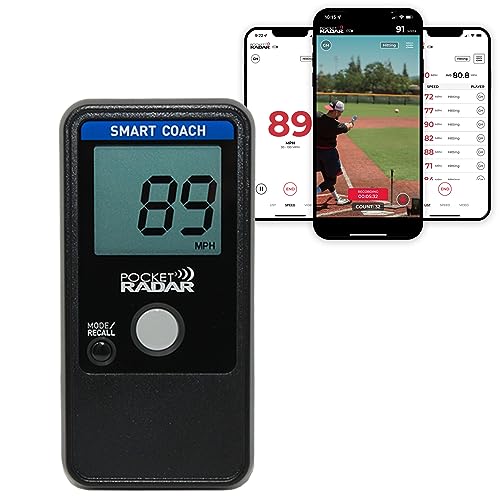 | Pocket Radar Smart Coach (with Sports App) | The real radar gun app: measured speed sent to your phone and embedded in video | ~$399 | View → |
 | TAG ONE Sports Radar (Rechargeable, App Integration) | App-connected real radar at a Ball Coach price, with a rechargeable battery | ~$300 | View → |
 | NET PLAYZ Velocity X Baseball Speed Radar (Narrow Beam) | The budget step up from an app: a hands-free pitcher radar under $120 | ~$114 | View → |
 | Bushnell MACH2 Smart Radar Gun (Baseball & Softball) | Full-size smart gun with a free app for programs | ~$600 | View → |
*Prices at time of writing, they move; check the listing.
Pocket Radar Ball Coach
~$299
The Ball Coach is the gun in most travel and high-school bags for a reason. It is the size of a phone, reads 25 to 130 mph with a published +/- 1 mph accuracy out to about 120 feet, has a hands-free Constant-On mode, remembers the last 25 readings, and any coach can pick it up and get a number in seconds. It is the cleanest answer to "I want real numbers without a pistol-grip gun." It does not connect to any app. If you want video and history, the Smart Coach below is the same radar with Bluetooth.
- +/- 1 mph published accuracy, about 120 ft reach
- Fits in a back pocket
- No pairing, no phone, no learning curve
- Two AAA batteries
- No app or video
- Needs a person holding it unless tripod-mounted
Bushnell Velocity Speed Gun
~$150
The Bushnell Velocity is the gun most families buy first. At about half the price of a Pocket Radar it is still a real Doppler radar, rated +/- 1 mph over 10 to 110 mph for ball sports. It is a pistol-grip unit rather than a pocket unit, reads a baseball from up to about 90 feet, and runs on two C batteries. The range is shorter than a Pocket Radar's, so stand close behind the catcher. For a backyard, a bullpen or a Little League field it gives you a trustworthy number no app can.
- Real radar for about half a Pocket Radar
- +/- 1 mph published accuracy
- Big, readable display
- No app, no pairing
- Bulky pistol grip
- About 90 ft baseball range
- No logging or video
Pocket Radar Smart Coach (with Sports App)
~$399
This is the answer for anyone who wanted a radar app in the first place. It is a real radar that sends every reading over Bluetooth to the Pocket Radar app, where the speed is embedded in video of the pitch, logged by session, exportable, and even called out loud. The number is measured, not estimated, and the video shows it. On a tripod in Constant-On mode it reads every pitch hands-free and shows the speed on your phone from the dugout. We compare it to the Ball Coach in Smart Coach vs. Ball Coach.
- Measured velocity embedded in video
- Session history and CSV export
- Hands-free tripod mode with phone readout
- Same +/- 1 mph accuracy as the Ball Coach
- $100 more than the Ball Coach for the app link
- Phone video burns battery on long days
TAG ONE Sports Radar (Rechargeable, App Integration)
~$300
The TAG ONE is the other way to get a phone app backed by a real radar. The maker lists +/- 1 mph accuracy, a 20 to 225 mph range, about 130 feet of reach, and a USB-C rechargeable battery rated around 6 hours, in a credit-card-size body. It pairs with the TAG Sports app for logging and player profiles, and the maker says the app can capture video. It costs about the same as a Ball Coach but adds an app. What you give up is Pocket Radar's longer track record.
- Real radar plus an app for about $300
- USB-C rechargeable
- Tiny, pocketable body
- Newer brand, shorter track record
- Maker specs less independently proven so far
NET PLAYZ Velocity X Baseball Speed Radar (Narrow Beam)
~$114
If the app was the budget play, this is the cheapest real hardware worth considering for a pitcher. It is a hands-free station that sits behind the catcher or net, with a narrow K/Ka-band beam the maker says ignores throws in the next lane. It has continuous or single-read modes, a reading recall and a large LCD you can read from the mound. It measures the ball directly, so none of the app's frame and distance errors apply. The maker claims +/- 1 mph. Treat that as a budget-maker claim, not a Pocket Radar-proven spec.
- Measures the ball, no typed distance or frame counting
- Hands-free continuous mode
- Large LCD readable from the mound
- Budget maker's accuracy claim
- No app or video
- Not for recruiting-grade numbers
Bushnell MACH2 Smart Radar Gun (Baseball & Softball)
~$600
The MACH2 is Bushnell's modern full-size radar for baseball and softball. It is rated +/- 1 mph over 20 to 125 mph, with about 130 feet of reach, a battery rated around 14 hours, and a display that can show release and exit velocity together. The free MACH2 app pairs over Bluetooth for remote triggering, a full-screen readout, audible speed calls and player profiles. At time of writing, video with a speed overlay and deeper tracking are paid upgrades inside the app. It is a program purchase. One family gets more from a Smart Coach.
- Full-size grip aims steadily from behind a backstop
- Release and exit velo on one display
- Free app with remote trigger and audible calls
- Most expensive pick
- Video overlay is a paid in-app upgrade
The verdict in one table: radar gun app vs. real radar gun
An app is a stopwatch with a camera; a radar gun is a measuring instrument. Here is the whole comparison:
| Radar gun app | Real radar gun | |
|---|---|---|
| What it measures | Video frames over a distance you type in | Doppler shift off the ball |
| Typical error | Several mph, unpredictable | About +/- 1 mph from the pitch line |
| Repeatability | Poor: same pitch, different number | Good: same pitch, same number |
| Setup | Enter distance, frame the pitch, tap | Point and trigger, or mount on a tripod |
| Cost | Free to a small subscription | About $150 to $400 one time for most buyers |
| Good for | Backyard fun, curiosity | Anything you will act on |
If you only read one line: buy the Pocket Radar Ball Coach if you want the number, the Smart Coach if you wanted an app, and the Bushnell Velocity if $150 is the budget.
Is there a radar gun app that actually works?
No phone app measures speed with radar, because phones do not have radar hardware for it. Apps with "radar" in the name use the word as marketing. Every one of them works the same way: it times the ball across a stretch of video and divides by a distance. Some are better than others at detecting the ball automatically and at using high-frame-rate video, which helps. None of them removes the distance problem, and none gives you a way to know whether a given reading is one of the good ones.
There is one exception to the "apps are toys" rule: apps that come with a real radar. The Pocket Radar app with the Smart Coach, the TAG Sports app with the TAG ONE and the MACH2 app with the Bushnell MACH2 all receive a measured number over Bluetooth. That is the "radar gun app" experience with a number you can trust.
How a radar gun app measures speed (and why it drifts)
You enter the distance the ball travels, the app records video at the phone's frame rate, and it detects (or asks you to mark) the frames where the ball leaves the hand and reaches the glove. Speed equals distance divided by elapsed time. Three errors stack up:
- The distance (the big one). Most people type the nominal mound distance, but the ball is released several feet in front of the rubber. On a 46-foot youth mound, the true flight is closer to 40 or 41 feet. Typing 46 inflates the reading by roughly 10 to 15 percent, which is about 5 to 8 mph on a 55 mph pitch, every time.
- The frame rate. At 60 frames per second, a 55 mph youth pitch from 46 feet crosses in about 34 frames. Missing the release or the catch by one frame changes the answer by about 3 percent (1 to 2 mph), and both ends can miss. At 240 fps the frame error shrinks a lot. The distance error does not.
- The tap and the detection. A tired thumb in the dugout is not a timing gate, and auto-detection can lock onto the glove, the bat or the arm instead of the ball.
Put those together and the same pitch can read a few mph apart across tries, with a built-in bias that depends on what distance you typed. A premium subscription does not add radar hardware to your phone.
How a real radar gun measures speed
A radar gun transmits a signal, receives the reflection off the moving ball and reads the frequency shift, which is proportional to the ball's speed toward the gun. There is no frame rate, no distance to type in and no tapping. The only variable you control is angle. The gun measures the part of the ball's speed heading directly at it, so standing 20 degrees off the pitch line reads roughly 6 percent low. Stand directly behind the catcher or pitcher and a $150 Bushnell, a $300 Pocket Radar and a scout gun all agree within a mile per hour or two.
That is why a gun number is something you can act on. Velocity programs, fatigue monitoring, exit velocity off a tee and recruiting clips all depend on a repeatable measurement, and only the gun provides one. The angle and release-versus-plate-speed details are in are Pocket Radars accurate?
Four situations where the app is good enough
An app is fine when the number is entertainment. A tee-ball parent who wants to say "he threw 30," a backyard contest between siblings, a coach curious whether the new kid is in the 40s or the 50s, or a one-time check before a family decides whether a gun is worth buying. In all of those, a reading that is a few mph off changes nothing.
If you do use an app, you can make it less wrong. Use the highest frame rate your phone offers, film from the side at a right angle to the throw, and enter the real release-to-glove distance (measure it once with a tape) instead of the mound distance. It is still an estimate, just a better one.
Four situations where the app will cost you
The moment a velocity number drives a decision, the app becomes a liability.
- Velocity programs: you cannot see a 2 mph gain with a tool that wobbles by more than that.
- Fatigue and pitch limits: coaches who pull a pitcher when his velocity drops several mph need a gun, not a guess. See pitch count rules by age.
- Recruiting and showcases: college coaches ignore self-reported app numbers, and an inflated one damages credibility.
- Arm care: a kid who is suddenly "down 6" on an app may be down zero, and a kid who is actually down 6 may read fine. Both outcomes are bad.
The fix is cheap. The Bushnell Velocity (about $150) is a real radar. If the budget stretches to about $300, the Pocket Radar Ball Coach is the dugout standard and the one we would buy.
Which real radar gun should you buy instead of an app?
Pick by budget and by whether you want a phone in the loop.
| Budget | Buy | Why |
|---|---|---|
| About $114 | NET PLAYZ Velocity X | Hands-free hardware that measures the ball; budget-tier trust |
| About $150 | Bushnell Velocity | Cheapest real radar from a known brand |
| About $299 | Pocket Radar Ball Coach | The dugout standard, no phone needed |
| About $300 | TAG ONE | Real radar plus an app, rechargeable |
| About $399 | Pocket Radar Smart Coach | The app experience with a measured number, speed in video |
| About $600 | Bushnell MACH2 | Full-size gun for programs, free app |
Pocket Radar buyers should read our best Pocket Radar guide for the tripod and Smart Display kits.
What to do with a real number once you have one
Compare it to the right benchmark, then stop obsessing. Our pitching speed by age chart gives typical and above-average ranges by age for baseball and fastpitch. Most 12-year-olds sit in the 50s, and most varsity arms sit from the mid 70s to the mid 80s. A real gun tells you where a pitcher sits and, more importantly, whether the trend over months is up. That is the whole point of measuring.
One more note for coaches: the gun reads the pitch, but it does not call it. The free MAVTRAX pitch-calling app sends the pitch call straight to a $13 speaker inside the catcher's helmet, and it runs on the same phone as the Pocket Radar app without conflict. Velocity in, pitch call out, one device.
Also worth a look

FAQ
Is there a radar gun app that is actually accurate?
No phone app measures speed with radar. They all estimate from video frames and a distance you enter, so none of them is repeatable within a mile or two the way a real gun is. The accurate 'radar apps' are the ones paired with real radars, like the Pocket Radar app with the Smart Coach.
How accurate are radar gun apps on iPhone?
It depends on the frame rate and, above all, the distance you enter. Typing the nominal mound distance instead of the real release-to-glove distance can inflate a youth reading by roughly 10 to 15 percent, and each missed frame at 60 fps adds a further 1 to 2 mph. High-frame-rate video helps, but it does not fix the distance problem.
Why does my radar gun app read higher than a real gun?
Usually the distance. The ball is released several feet in front of the rubber, so the real flight is shorter than the mound distance most people type in. The app divides a too-long distance by the real time and reports a speed that is too high.
What is the cheapest real radar gun for baseball?
The Bushnell Velocity at about $150 is the cheapest real Doppler radar from an established brand, rated +/- 1 mph. The NET PLAYZ Velocity X (~$114) is a cheaper hands-free option, but its accuracy claim comes from a budget maker.
Does Pocket Radar have an app?
Yes, and it works only with the Smart Coach, which sends measured readings over Bluetooth for speed embedded in video, history and export. The Ball Coach does not connect to the app.
Can a radar gun measure exit velocity off a tee?
Yes. Stand behind the tee in line with the ball's flight and trigger as the hitter swings. Pocket Radars, the TAG ONE and the Bushnell guns all read exit velocity. Apps struggle here because the ball leaves the frame fast.
Why do scouts' guns read higher than mine?
Usually angle and timing. Scouts sit directly behind home plate and catch release speed; a parent at the side of the backstop reads low. Some guns also report plate speed, which is several mph below release speed for the same pitch.
We're the team behind MAVTRAX, a free pitch-calling app. This is a research guide: picks are chosen on manufacturer specs, league rules, build quality and real-world price, checked against live listings, not on who pays the highest commission. We haven't hands-on tested every product. Full criteria on how we pick.