Best 12-Inch Practice Softballs (2026): Leather, Synthetic & Pitching-Machine Picks
Practice softballs are the cheapest thing in the bag and the first thing teams run short on. Here are the dozens worth buying — from a fair-priced bucket-filler to real leather balls and the reinforced ones built to survive a pitching machine.
In this guide · 10 sections
Quick picks
Our top recommendations — full reviews below.

Filling a practice bucket without overpaying
~$56 price and availability on Amazon
View on Amazon →Key takeaways
- For 12U and up, the 12-inch softball is standard; 10U and younger generally use an 11-inch ball — confirm with your league before you order.
- Don't feed leather game balls into a pitching machine — use machine-specific balls; save practice balls for buckets and BP, and keep game balls for games.
- Leather covers feel best and cost the most; synthetic covers shrug off wet and outdoor use; dimpled/poly balls are cheap pitching-practice ammo.
- Buy at least a dozen so practice doesn't stop while someone chases balls around the field.
- Our value pick is the Epic Fastpitch dozen (about $56); for real leather feel, the PHINIX Leather; for machines, the Baden Ballistic.
- Keep balls dry and stored indoors — a wet, swollen ball loses its shape and feel fast.
- The .47 COR / 375 lb compression fastpitch standard exists, but it's a game-ball spec — practice balls are about durability and quantity, not matching a number.
The best all-around practice softball for most teams is the Epic Fastpitch dozen (about $56) — a fair-priced bucket of workhorse balls — with the PHINIX Leather ball for game-like feel and the Baden Ballistic for anything that goes through a pitching machine. Practice balls are easy to overlook: they're the cheapest item in the bag, so coaches grab whatever's on the shelf, then wonder why the bucket is half-flat by August. The trick is matching the ball to the job — buckets and batting practice, game-like reps, or machine work — and buying enough of them.
Below are the dozens and balls worth buying, who each is for, and how to pick the right size, cover, and quantity so your practices keep moving.
At a glance
| Pick | Best for | Price* | ||
|---|---|---|---|---|
| Epic Fastpitch 12" Practice Softballs (Dozen) | Filling a practice bucket without overpaying | ~$56 | View → |
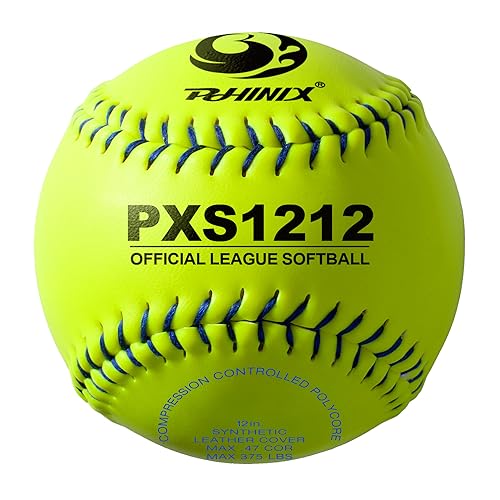 | PHINIX 12" Leather Practice Softball | Practice that feels like a real game ball | ~$56 | View → |
 | PHINIX Split-Leather Practice Softball | Leather feel that takes more abuse | ~$62 | View → |
 | Champion Sports 12" Syntex Softballs | Outdoor and wet-weather practice in quantity | ~$80 | View → |
 | Baden Ballistic 12" Pitching-Machine Softball | Surviving a pitching machine | ~$108 | View → |
*Prices at time of writing — they move; check the listing.
Epic Fastpitch 12" Practice Softballs (Dozen)
~$56
A full dozen practice balls at a fair price — this is the workhorse bucket-filler most teams actually need. For batting practice, soft toss, fielding reps, and tee work, you want quantity so practice never stops while someone hunts down a stray ball, and the Epic dozen gets you there for roughly the price of a few premium singles.
These aren't the balls you save for game day — they're the ones you beat up all season. That's exactly the point: buy a dozen, keep the bucket full, and let them take the abuse so your game balls don't.
- A full dozen for the price of a few premium balls
- Plenty of quantity to keep a bucket full
- Fine for BP, soft toss, tee work, and fielding reps
- The sensible default for most teams
- Practice-grade feel, not a game ball
- Not built for repeated pitching-machine use
PHINIX 12" Leather Practice Softball
~$56
Real leather cover, game-like feel for practice. When a player needs reps that mirror what they'll see on game day — the weight in the hand, the way it comes off the bat, the grip on a release — a leather practice ball is worth the upgrade over synthetic. The PHINIX leather ball gives you that feel without burning through your actual game balls.
Leather is the premium cover and it shows in the hand, but treat it accordingly: keep it dry and don't run it through a machine. Use these for live BP, pitcher and catcher work, and any rep where feel matters.
- Genuine leather cover with a game-like feel
- Great for live BP and feel-sensitive reps
- Saves wear on your actual game balls
- Premium build in the hand
- Pricier per ball than synthetic practice balls
- Leather hates moisture — keep it dry, no machine use
PHINIX Split-Leather Practice Softball
~$62
A split-leather cover built to take a beating. Split leather trades a little of the buttery feel of full-grain for noticeably better toughness, which makes this the pick when you want a leather ball that survives a hard-working practice schedule rather than getting babied. For teams that drill heavy and don't want to replace leather balls every few weeks, the durability earns its keep.
- Split-leather cover built for durability
- Leather feel with better toughness than full-grain
- Holds up to a heavy practice schedule
- Good middle ground between feel and longevity
- Costs a bit more than the standard leather ball
- Still leather — keep it out of the rain and the machine
Champion Sports 12" Syntex Softballs
~$80
Synthetic-cover balls that hold up outdoors, in team quantity. The synthetic (Syntex) cover is the practical answer to the leather problem: it shrugs off damp grass, dew, and the occasional rain delay that would warp and swell a leather ball. Buy these for the field that's always a little wet, or for a program that leaves balls in the shed between practices.
The trade-off is feel — synthetic never quite matches leather in the hand — but for sheer durability and team-quantity value, it's the cover that lasts.
- Synthetic cover holds up in wet and outdoor conditions
- Team-quantity value
- Far more weather-tolerant than leather
- Low-maintenance — won't swell when damp
- Synthetic feel isn't as game-like as leather
- Higher upfront cost for the quantity
Baden Ballistic 12" Pitching-Machine Softball
~$108
Reinforced, seamless-style balls made to survive machine use. A pitching machine chews up ordinary balls — the wheels grab the cover and seams and shred them quickly, and worse, a leather game ball fed through a machine gets beaten out of shape. Machine-specific balls like the Baden Ballistic are built without the vulnerable raised seams and with a tougher construction so they cycle through a machine again and again.
If you have a machine, get balls made for it. It's cheaper in the long run than replacing torn-up practice balls, and it protects your machine from the uneven wear that mismatched balls cause.
- Reinforced/seamless-style build for machine durability
- Cycles through a machine repeatedly without shredding
- Protects your machine from uneven wear
- Purpose-built for the one job most balls fail at
- Most expensive option here
- Overkill if you don't own a pitching machine
11-inch vs. 12-inch: which size by age?
For 12U and up, the 12-inch softball is standard; 10U and younger generally use a smaller 11-inch ball. The size step exists so younger players can grip, throw, and field a ball scaled to their hands — an 11-inch ball is easier for a 9- or 10-year-old to control, while the 12-inch is the regulation size players carry through the rest of their fastpitch careers. Buying the wrong size means a bucket your team can't actually use in practice the way they play in games.
That said, divisions and local rules vary, so always confirm with your specific league before you order a dozen. The article you're reading is about the 12-inch ball used at 12U and up; if your player is 10U or younger, look for the 11-inch version of the same balls.
| Age division | Typical ball size |
|---|---|
| 10U and younger | 11-inch |
| 12U and up | 12-inch |
| High school / college | 12-inch |
Practice vs. game vs. pitching-machine balls
Use practice balls for buckets and BP, save game balls for games, and use machine-specific balls in a pitching machine — don't mix the three. Each is built for a different job. Practice balls are about durability and quantity: you want a dozen you can beat up at soft toss, tee work, and fielding without a second thought. Game balls are the nicer, more consistent balls you keep aside so they're fresh on game day. And a pitching machine needs balls made to survive its wheels.
The single most common (and expensive) mistake is feeding leather game balls into a machine — the wheels grab the cover and seams, shred the ball, and beat it out of round. Keep your buckets sorted and your gear lasts far longer.
| Ball type | Use it for | Avoid |
|---|---|---|
| Practice | Buckets, BP, soft toss, tee, fielding | Game day if you want consistency |
| Game | Actual games — kept fresh | Pitching machines, beat-up drills |
| Pitching-machine | Anything that goes through the machine | — |
Leather vs. synthetic vs. dimpled covers
Leather feels best and costs the most; synthetic survives wet and outdoor use; dimpled/poly balls are the cheapest pitching-practice ammo. Cover choice is really a choice about feel versus durability. Leather gives the truest game-like feel in the hand and off the bat, which is why it's the pick for reps where feel matters — but it hates moisture and shouldn't go near a machine. Synthetic covers don't feel quite as good but they shrug off damp grass and outdoor storage, making them the low-maintenance team choice.
Dimpled and poly balls are a third category: cheap, hard-wearing balls often used for pitching practice and machine-style drills where you just need a lot of them and don't care about a refined feel. Match the cover to what the practice actually demands.
How many should you buy?
Buy at least a dozen — a bucket that runs dry stops practice while everyone chases balls. The whole reason a practice ball is cheap is so you can own a lot of them. With a full dozen, a hitter can take a real round of BP without pausing every few swings; with two dozen across two buckets, you can run a hitting station and a fielding station at the same time. Skimping on quantity is a false economy — it costs you practice reps, which are the entire point.
For an individual player drilling at home, a half-dozen to a dozen still beats constantly re-gathering one or two balls between every rep.
Care and storage: keep them dry
Keep softballs dry and stored indoors — moisture is what kills a ball's shape and feel. A wet leather ball swells, loses its round shape, and never quite recovers; even synthetic balls last longer when they're not left out in a damp shed or a bag of wet grass. After a rainy practice, pull the balls out, let them dry, and don't seal them up soaking wet.
Sort your buckets too: keep practice, game, and machine balls separate so a game ball doesn't accidentally end up shredded in the machine. A little organization makes a $56 dozen last a whole season instead of half of one.
A note on the .47 / 375 standard
You'll see fastpitch balls marked with a COR and compression rating — commonly the .47 COR / 375 lb compression standard — but that's a game-ball spec, not something to shop practice balls by. Those numbers describe how a regulation game ball is supposed to perform (its liveliness and firmness) and matter when your league specifies a stamped game ball. For practice balls, what actually matters is the right size for your age division, a cover that suits your conditions, and buying enough of them. Don't overthink the rating on a bucket of BP balls.
Also worth a look
 Rawlings Dream Seam Game SoftballsRawlings Dream Seam — premium GAME balls (~$113)~$113 · View on Amazon →
 Fastpitch Batting Tee (Tanner-style)A fastpitch tee for solo reps~$100 · View on Amazon →
FAQ
What is the best practice softball?
For most teams, the Epic Fastpitch dozen (about $56) is the best value — a full bucket of durable workhorse balls at a fair price. For game-like feel, the PHINIX Leather ball is the upgrade; for a pitching machine, use the Baden Ballistic.
What size softball does my player need?
For 12U and up, the 12-inch ball is standard. 10U and younger generally use a smaller 11-inch ball. Divisions and local rules vary, so confirm with your specific league before ordering.
Can I use practice balls in a pitching machine?
Use machine-specific balls like the Baden Ballistic instead. A pitching machine grabs and shreds ordinary cover-and-seam balls, and feeding leather game balls through a machine beats them out of shape — machine balls are built to survive the wheels.
Leather or synthetic practice balls — which is better?
Leather feels best and is closest to a game ball, but it hates moisture and costs more. Synthetic covers don't feel quite as game-like but shrug off wet and outdoor use, making them the durable team choice. Dimpled/poly balls are the cheap pitching-practice option.
How many practice softballs should I buy?
At least a dozen for a team bucket so practice never stops to chase balls. Two dozen lets you run a hitting station and a fielding station at once. Even a solo player drilling at home benefits from a half-dozen to a dozen.
What's the difference between practice and game softballs?
Practice balls are about durability and quantity for buckets, BP, and drills; game balls are nicer, more consistent balls you keep fresh for actual games. Keep them in separate buckets and don't beat up your game balls in practice.
How do I store softballs so they last?
Keep them dry and indoors. Moisture makes a ball swell and lose its shape — a wet leather ball never fully recovers. Dry balls out after a rainy practice and don't seal them up soaking wet.
What does .47 / 375 mean on a softball?
It's a game-ball performance standard — .47 COR (liveliness) and 375 lb compression (firmness). It matters when your league requires a stamped game ball, but it's not what you shop practice balls by. For practice, focus on size, cover, and quantity.
We're the team behind MAVTRAX — pitch-calling software used by baseball and softball teams from 9U travel ball up. We spend our days around dugouts, gear bags and tournament weekends. Picks are chosen on specs, durability for youth-sports abuse, real-world price, and owner feedback — not on who pays the highest commission. Full criteria on how we pick.