Best Baseball Batting Gloves (2026): 8 Verified Pairs From $17 Youth to Bruce Bolt
The best batting gloves for most players are the Franklin CFX Pro (about $36): the pro-standard leather palm and fit that made Franklin the official batting glove of MLB. Here are 8 verified pairs from a $17 youth workhorse to $65 Bruce Bolts, with sizing by age and the durability truth nobody puts on the package.
In this guide · 7 sections
Quick picks
Our top recommendations — full reviews below.

The pro-standard glove for most players, adult and youth
~$36 price and availability on Amazon
View on Amazon →Key takeaways
- Best overall: the Franklin CFX Pro (about $36), the sheepskin-palm pro standard that fits like it was painted on and comes in adult and youth sizes.
- Best premium: Bruce Bolt Original Series (about $65). The thick Cabretta leather palm genuinely outlasts standard gloves, which is how a $65 pair can beat buying two $30 pairs a season.
- Best youth value: Franklin Digitek (about $17). Growing hands shred and outgrow gloves; pay for fit, not longevity, until the hands stop growing.
- Fit rule: snug everywhere, no loose fingertip material. Extra fabric at the fingertips folds under the grip and causes the exact rubbing a glove should prevent.
- All batting gloves are consumables. Palms wear through from bat knob friction; heavy hitters kill a pair in months. Budget accordingly and keep a backup pair in the bag.
- Pair the purchase properly: gloves protect the hands, the helmet protects the head, and the right-size bat protects the swing.
The best baseball batting gloves for most players are the Franklin CFX Pro, about $36: the same line the majority of big leaguers actually wear (Franklin is the official batting glove of MLB), with a soft sheepskin palm and a second-skin fit in both adult and youth sizes. If you want one pair that does everything well, buy that and stop reading.
The longer answer is that batting gloves are a consumable with three real tiers: youth pairs where fit matters and durability doesn't (hands grow faster than palms wear), mid-tier adult pairs in the $23-50 range where the brands mostly trade blows, and the premium tier where Bruce Bolt's thick Cabretta leather changed the durability math. Below are 8 verified pairs across all three tiers, the sizing chart by age, and how to make any pair last longer. All links are live-verified listings; prices move with size and colorway, so treat every number as approximate.
At a glance
| Pick | Best for | Price* | ||
|---|---|---|---|---|
| Franklin CFX Pro Batting Gloves | The pro-standard glove for most players, adult and youth | ~$36 | View → |
 | Bruce Bolt Original Series Short Cuff | Serious hitters who want the longest-lasting palm made | ~$65 | View → |
 | Franklin Pro Classic Batting Gloves | Traditional full-leather look and feel | ~$30 | View → |
 | Rawlings Workhorse Batting Gloves | Durability-first hitters who won't pay Bruce Bolt money | ~$50 | View → |
 | Easton Walk-Off Ethos Batting Gloves | A modern performance fit with premium touches | ~$44 | View → |
 | Marucci Signature V4 Batting Gloves | Clean-look quality from the players' brand | ~$31 | View → |
 | Under Armour Clean Up Batting Gloves | The dependable budget adult pair | ~$23 | View → |
 | Franklin Digitek Batting Gloves (Youth) | Growing hands that will outgrow any glove by June | ~$17 | View → |
*Prices at time of writing — they move; check the listing.
Franklin CFX Pro Batting Gloves
~$36
The CFX Pro is the most-worn batting glove in professional baseball's dugouts for a simple reason: the sheepskin leather palm is soft enough to feel the bat and tough enough to last a season of honest use, and Franklin's tectonic-fit backhand flexes exactly where hands flex. It comes in a huge range of sizes and colorways across adult and youth, which is why it's the default answer at every level from 10U to the show.
At about $36 it is mid-priced, replaceable without pain, and better fitting than anything cheaper. The default buy.
- Pro-standard sheepskin palm feel
- Excellent flexible fit
- Huge size and color range, adult and youth
- Fair price for the quality
- Standard-thickness palm wears like any non-premium glove
- White colorways show dirt immediately
- Sizing runs snug; check the chart
Bruce Bolt Original Series Short Cuff
~$65
Bruce Bolt built its reputation on one spec: a much thicker Cabretta leather palm than standard batting gloves, which is why players who take hundreds of swings a week swear by them. The thick palm resists the knob-friction wear that kills normal gloves, and the break-in leaves a molded, tacky feel that serious hitters describe as the best in the game.
At about $65 the math only works for volume: a travel player hitting year-round who burns through three $35 pairs annually comes out ahead; a rec player does not. For the hitter whose gloves always die at the palm heel, this is the fix.
- Thick Cabretta palm outlasts standard gloves
- Premium molded feel after break-in
- The status glove of travel ball
- Short and long cuff options
- Twice the price of the mid tier
- Overkill for casual play
- Sizes sell out in popular colorways
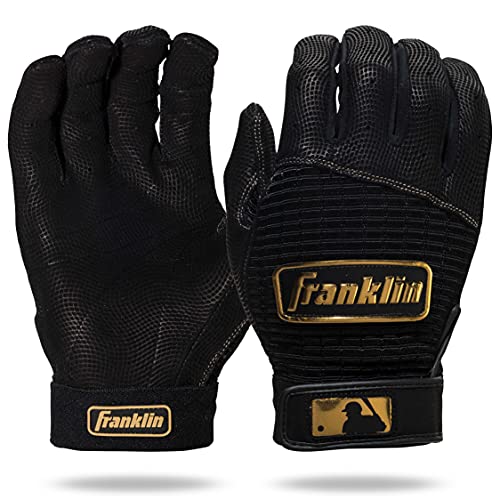
Franklin Pro Classic Batting Gloves
~$30
The Pro Classic is the old-school companion to the CFX: cleaner styling, a quality leather palm, and none of the modern-graphic look that some players (and some high school dress codes) want to avoid. Functionally it delivers most of the CFX experience for a few dollars less.
If the choice between the two Franklins comes down to anything, it's aesthetics and small fit differences; you are buying the same brand competence either way.
- Clean traditional styling
- Quality leather palm
- Slightly cheaper than the CFX Pro
- Team-uniform friendly colorways
- Fewer bells than the CFX backhand
- Standard palm durability
- Less size availability at any given moment
Rawlings Workhorse Batting Gloves
~$50
The Workhorse name is the pitch: Rawlings reinforces the high-wear zones and uses a heavier-duty palm than typical mid-tier gloves, aiming at exactly the player who wears through pairs too fast. It lands between the standard tier and Bruce Bolt in both price and lifespan, and its compression-strap wrist gives a locked-in fit that hitters with smaller wrists especially like.
At about $50 it's the sensible durability upgrade: real extra lifespan, without the premium-tier price.
- Reinforced high-wear palm zones
- Locked-in strap fit
- Meaningful durability upgrade over $30 gloves
- Rawlings sizing consistency
- Not as long-lived as thick-palm premium gloves
- Heavier feel than thin-palm gloves
- Mid-$40s to $50 depending on size
Easton Walk-Off Ethos Batting Gloves
~$44
Easton's Walk-Off line is its flagship batting glove, and the Ethos generation brings a soft leather palm with a stretchy, seam-minimized backhand that moves like athletic tape. Players who find traditional gloves stiff across the knuckles tend to love this construction.
At around $44 it competes with the upper-mid tier on feel rather than durability; treat it as a performance glove for game days, with a cheaper pair for cage volume.
- Excellent flexible backhand
- Soft, connected palm feel
- Modern styling players like
- Locked-in wrist closure
- Feel-first build, not a durability play
- Pricier than the Franklins
- Colorway availability varies
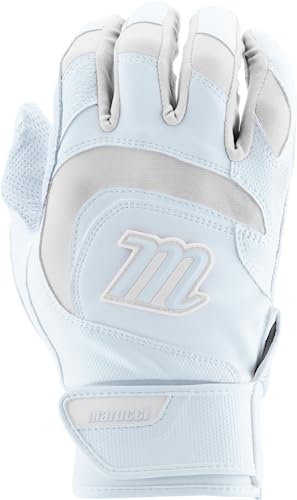
Marucci Signature V4 Batting Gloves
~$31
Marucci built its bat empire on pro clubhouses and the Signature glove carries the same understated DNA: quality leather palm, minimal branding, and a dialed fit at a price under the Franklin CFX. It is the quiet value in the adult tier and the pick for players already swinging Marucci lumber who want the matching look.
Nothing flashy to report, which is the point: a well-made $31 glove from a serious brand.
- Quality palm at a low-$30s price
- Understated styling
- Consistent Marucci sizing
- Great pair to keep as backup
- Standard durability
- Limited color range
- Less common in youth sizes
Under Armour Clean Up Batting Gloves
~$23
The Clean Up has been UA's volume batting glove for years: synthetic-blend palm, heat-gear backhand, and a price that makes it the default "grab two pairs" choice. The palm feel is a step below leather gloves, but the fit is athletic and the durability is honestly fine for the price.
At about $23 it's the right answer for rec league play, batting cage sessions, and every bag that needs a backup pair.
- Lowest adult price here
- Breathable backhand
- Fine cage-session workhorse
- Wide size availability
- Synthetic palm feel
- Wears faster than leather at volume
- Basic wrist closure
Franklin Digitek Batting Gloves (Youth)
~$17
The Digitek is the answer to youth batting glove economics: hands grow a size a year, so the $17 pair that fits today beats the $40 pair bought roomy. The digital-camo synthetic palm grips well, the sizes run down to true small-kid hands, and Franklin's youth sizing is the most reliable in the category.
Buy the size that fits now, expect to buy again next season, and put the savings toward the bat that actually fits.
- True youth sizing down to small hands
- Grippy palm for the price
- Cheap enough to replace on schedule
- Tons of colorways kids like
- Synthetic palm, modest lifespan
- Not for serious teen volume
- Runs snug; size up if between
Batting glove sizing by age
Measure from the base of the palm to the tip of the middle finger and match the maker's chart; when between sizes, most players prefer the snugger one. Rough age mapping:
| Player | Typical size |
|---|---|
| Tee ball / 6U-7U | Youth S |
| 8U-10U | Youth M |
| 11U-13U | Youth L to Adult S |
| High school | Adult S-L |
| Adult | Adult M-XL |
The fit test: fingers reach the tips with no bunched material, the palm has zero loose fabric (loose palm material folds under the grip and blisters the hand it was supposed to protect), and the wrist closure lands mid-strap. Brands run different: Franklin snug, UA athletic, Rawlings true.
Why palms die, and how to slow it down
Batting gloves fail at the bottom-hand palm heel, where the bat knob grinds on every swing. Four habits that meaningfully extend life: (1) rotate two pairs so each dries fully between sessions (sweat-soaked leather abrades fastest); (2) keep cage sessions on a cheap pair and game days on the good pair; (3) air-dry only, never a dryer, which cooks leather stiff; (4) fix grip before blaming gloves, because a death-grip or a shredded bat grip tape chews palms regardless of brand. When the palm heel goes shiny and thin, retirement is close; when it tears, it's done.
Do batting gloves actually matter?
Honest answer: they solve three real problems and one imaginary one. Real: sting damping on mishits (especially in cold weather with alloy bats), blister prevention at volume, and consistent grip when hands sweat. Imaginary: extra bat speed; no glove swings the bat for you. This is why our youth advice is fit-first and cheap, and why the premium tier only pays off for hitters taking hundreds of swings a week. Cold-weather note: gloves plus a properly sized bat matter most in early spring and fall ball, when a mishit on a 45-degree morning stings for an inning.
Also worth a look
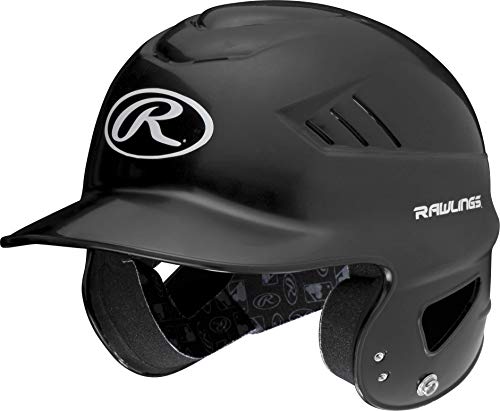 Rawlings COOLFLO Batting Helmet (One Size Fits Most)The best-overall batting helmet from our helmet guide~$32 · View on Amazon →
 Franklin Youth 'Grow to Pro' Batting GlovesFranklin's Grow to Pro pair for the youngest hitters~$20 · View on Amazon →
 Tanner Tee The Original Batting Tee – Adjustable Pro Hitting Tee for BasebalThe pro-standard tee from our batting tee guide$99.99 · View on Amazon →
FAQ
What are the best baseball batting gloves?
Our best overall is the Franklin CFX Pro at about $36, the pro-standard pair with a sheepskin palm in adult and youth sizes. Best premium is the Bruce Bolt Original Series (about $65) for durability, and the best youth value is the Franklin Digitek at about $17.
Are Bruce Bolt batting gloves worth it?
For high-volume hitters, usually yes: the thick Cabretta leather palm outlasts standard gloves, so a $65 pair can beat buying multiple $30-40 pairs a season. For rec players who swing a few times a week, a $23-36 pair is the smarter spend.
What size batting gloves does a 10 year old need?
Most 10-year-olds wear Youth Medium, moving to Youth Large around 11-12. Measure palm base to middle fingertip and use the maker's chart; fingers should reach the glove tips with no bunched material, and when between sizes go snugger.
Do batting gloves make a difference?
They damp sting on mishits, prevent blisters during high-volume hitting, and keep grip consistent when hands sweat. They do not add bat speed. The difference is most noticeable in cold weather and long cage sessions.
How long do batting gloves last?
A frequent hitter wears through a standard pair in a few months; a rec player can get a season or more. Palms fail first, at the bottom-hand heel. Rotating two pairs, drying them fully between uses, and keeping cage work on a cheap pair roughly doubles lifespan.
Should kids wear batting gloves in tee ball?
Optional. At tee ball ages gloves are mostly about comfort and confidence. A cheap youth pair like the Franklin Digitek or Grow to Pro is plenty; prioritize a helmet that fits and a correctly sized bat first.
We're the team behind MAVTRAX — pitch-calling software used by baseball and softball teams from 9U travel ball up. We spend our days around dugouts, gear bags and tournament weekends. Picks are chosen on specs, durability for youth-sports abuse, real-world price, and owner feedback — not on who pays the highest commission. Full criteria on how we pick.