Wireless Pitch Calling Systems (2026): Range, Bluetooth vs. Radio, and Interference
A wireless pitch calling system carries the call from the dugout to the catcher's helmet over a short-range link: standard Bluetooth for app systems, a proprietary radio for hardware kits. Both easily cover a normal dugout-to-plate distance when the caller stands in the right place. Here is how far each reaches, what actually causes dropouts at a ballpark, and a five-minute range test to run on every new field.
In this guide · 13 sections
- Helmet headset
- How does a wireless pitch calling system send the call?
- How far is the dugout from home plate?
- How much range does Bluetooth really have?
- Bluetooth vs. proprietary radio: what is the difference?
- What causes wireless interference at a ballpark?
- How fast does a wireless pitch call arrive?
- Where does the receiver go in the catcher's helmet?
- Battery life: how long does a wireless system last?
- How to run a five-minute range test on any field
- Wireless troubleshooting: symptom, cause, fix
- Which wireless pitch calling system fits your program?
- FAQ
Key takeaways
- Every wireless pitch calling system is short range by design: it only has to cover the dugout-to-plate distance, not the whole complex, and it needs no Wi-Fi or cell service.
- App systems use Bluetooth (2.4 GHz, phone to headset); hardware kits use their own proprietary radio. Both work; the differences show up at the edges.
- Distance is rarely the real problem. Obstacles are: bodies, a chain-link fence, a concrete dugout and a phone in a back pocket all cut 2.4 GHz range.
- Stand at the dugout opening and hold the phone in your hand; that one habit fixes most Bluetooth dropouts.
- A paired Bluetooth headset connects only to devices it trusts, so another team's phone cannot take over your catcher's headset in normal use.
- Run a five-minute range test on every new field with the catcher in full gear, before warmups end.
A wireless pitch calling system sends the pitch call from the person calling the game to a speaker in the catcher's helmet over a short-range wireless link. App systems use standard Bluetooth from the coach's phone to a helmet headset; hardware kits use their own proprietary radio from a keypad to a receiver. Both are designed to cover the distance from the dugout to home plate, and both work without Wi-Fi or cell service.
This guide covers the wireless side of pitch calling: how far each kind of link reaches, how far your dugout really is from the plate, Bluetooth versus proprietary radio, what causes interference and dropouts at a ballpark, battery life, and a range test you can run in five minutes. If you are choosing between whole systems, the electronic pitch-calling systems hub compares all four types, and prices live on pitch-calling system cost. We build MAVTRAX, a free app that uses the Bluetooth route.
How does a wireless pitch calling system send the call?
Every wireless system has a transmitter, a link and a receiver. The only question is what each one is.
| Part | App system | Hardware kit | Helmet intercom |
|---|---|---|---|
| Transmitter | Coach's phone | Keypad worn or held by the caller | Intercom unit worn by the coach |
| Link | Bluetooth, phone to headset | The maker's own radio | Bluetooth intercom, unit to unit |
| Receiver | Helmet-mount headset pod | Proprietary receiver | Helmet-mount intercom pod |
| What is sent | Pre-recorded spoken call from the phone | Button code, played as a call by the receiver | The coach's live voice |
None of these links touches the internet. That matters on tournament back fields with no signal: a wireless pitch calling system is a private little network between two or three devices, and it works the same with zero bars as with five. The one caveat for apps is to open the app once with signal so its audio is stored on the phone; after that, MAVTRAX runs fully offline.
How far is the dugout from home plate?
Farther than it looks, and it varies a lot by field. The distance your system has to cover is from wherever the caller actually stands to the catcher's helmet, which on many fields means from a dugout set down the first- or third-base line, across foul territory, to the plate. Youth complexes, high school fields and college parks all differ, and even two fields at the same complex can differ.
So do not guess; measure. Pace it off from the dugout opening to home plate (an adult walking stride is roughly two and a half to three feet), or count the fence panels. Then do the same from the back bench. Two things usually jump out:
- The back of the dugout adds real distance and puts a fence, a wall and several bodies between the phone and the catcher.
- Visiting dugouts are not always symmetric. The other side can be longer or more enclosed than the side you practiced on.
The practical rule that falls out of this: call from the dugout opening, phone in hand, with a clear line toward the plate. That single habit handles the distance on most youth and high-school fields.
How much range does Bluetooth really have?
More than a dugout needs in open air, less than you would hope through bodies and metal. Bluetooth devices are built to power classes. Most headsets and phones are designed around the common short-range class, often quoted at about 10 meters (roughly 33 feet) of reliable range, while higher-power devices and newer Bluetooth versions can reach much farther in open air. Product listings quote their own numbers, and they are measured in ideal conditions.
Real-world range at a ballpark depends mostly on what sits between the phone and the helmet:
- People. The human body absorbs 2.4 GHz signals, which is the band Bluetooth uses. A phone in a back pocket behind the coach's own body, facing away from the field, can lose a big share of its range.
- Metal. Chain-link fences, metal dugout roofs and bat racks reflect and block the signal.
- Line of sight. A phone held up at the dugout opening sees the catcher; a phone on the back bench sees a wall.
That is why the same headset that is flawless in the backyard can stutter from the back of a concrete dugout. It is also why the fix is almost always placement, not a new headset. If you coach at the same park often, find the spot that works and call from it every time.
Bluetooth vs. proprietary radio: what is the difference?
Hardware kits use their own radio link rather than Bluetooth; app systems use Bluetooth because every phone and every helmet headset already has it. Here is what that difference actually means on the field.
| Bluetooth (app systems) | Proprietary radio (hardware kits) | |
|---|---|---|
| Hardware | Any phone plus any Bluetooth helmet headset | The maker's own transmitter and receivers only |
| Band | 2.4 GHz, shared with Wi-Fi and other Bluetooth devices | Set by the maker; details are not something we have verified |
| Coexisting with other devices | Frequency hopping moves around busy channels | Designed for the job; the maker describes the link as secure |
| Who can connect | Only devices the headset has been paired with | Only the kit's own devices |
| Players on one call | Typically one headset per phone connection | Several receivers from one transmitter |
| Replacing a receiver | Another ~$13 helmet headset | About $500 per receiver as of Aug 2026 |
The honest summary: a dedicated radio can have more headroom in a very crowded radio environment and makes it easy to put several players on one call. Bluetooth wins on cost, on replacement and on using hardware you already own, and it comfortably covers the dugout-to-plate distance when the caller stands in the right place. For the full app-versus-hardware decision beyond the radio, read pitch calling app vs. hardware kit.
What causes wireless interference at a ballpark?
The 2.4 GHz band is busy at a tournament: hundreds of phones, earbuds, smartwatches, a concession stand's Wi-Fi, streaming cameras and possibly other teams' pitch-calling systems all share it. Bluetooth was built for exactly this. It hops rapidly across many channels in the band and adapts away from channels that are noisy, which is why a crowded complex usually produces the occasional stutter rather than a dead link.
What coaches experience as "interference" is more often one of these:
- Too many obstacles. Body, fence, wall. See the range section above.
- The phone's other connections. A coach's phone connected to a car, a smartwatch and earbuds at the same time is juggling. Disconnect everything except the catcher's headset during games.
- Low battery. A headset at the end of its charge can drop out before it dies.
- Power saving. Aggressive battery-saver modes on some phones can throttle Bluetooth. Turn them off for the game.
Can another team connect to our headset? In normal use, no. A paired Bluetooth headset reconnects to the devices it already trusts, and it only accepts new devices when you put it into pairing mode. Pair at home, never leave the headset in pairing mode at the field, and nobody else's phone will be talking to your catcher.
How fast does a wireless pitch call arrive?
About a second from tap to ear with a well-built app, and faster than the old sign exchange either way. Two things set the delay. The first is how the audio is produced: MAVTRAX plays pre-recorded calls stored on the phone, so nothing streams or waits on a server. The second is the Bluetooth audio path itself, which adds a small delay in every headset.
In practice, what matters is that the call lands before the catcher needs to set up, which is several seconds after the previous pitch. If a call ever feels late, the cause is almost always a weak link (move the phone) or the coach tapping late (a rhythm issue that disappears after a practice or two).
Where does the receiver go in the catcher's helmet?
Inside the ear flap, as part of the helmet. The wireless link only works if the receiver is still on the catcher after every pop-up, and catchers rip the helmet off constantly. Earbuds and loose speakers fall out; a speaker mounted inside the helmet rides along.
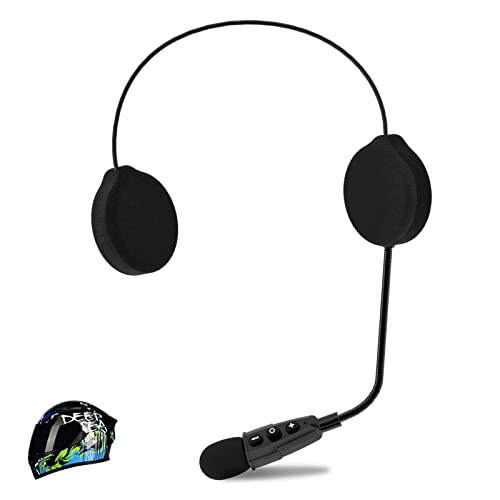
For app and intercom systems the receiver is a motorcycle-style helmet-mount Bluetooth headset: a thin speaker pod velcroed inside the ear flap, a wire tucked behind the padding and a small control unit on the shell. Our top pick is the ELIKIDSTO IPX7 helmet-mount headset at about $13, rated around 50 hours per charge. Mount it with how to install a Bluetooth headset in a catcher's helmet: one ear only, pod centered over the ear hole, the other ear left open for the umpire.
Two wireless tips for the install. Put the control unit where the catcher's head does not sit between it and the dugout for most of the game if you can, and keep the pod flat against the padding so the mask does not press it. If your catcher's helmet is snug, or you want an intercom-capable unit, compare models in best Bluetooth headsets for a catcher's helmet.
Battery life: how long does a wireless system last?
Wireless means batteries, and a dead battery is the most common game-day failure for every system. A tournament Saturday can be six to eight hours of on-time for the catcher's headset and the coach's phone.
- Headset: our top pick is rated around 50 hours per charge; other helmet units are rated from about 13 to 25 hours and up. Charge them the night before anyway.
- Phone: screen-on time is what drains it. Carry a power bank for doubleheaders and tournament days.
- Hardware kits: every transmitter and receiver needs charging between games. Assign one person to own it.
- Heat: a car trunk in July is hard on every lithium battery. Keep the gear bag in the shade.
How to run a five-minute range test on any field
- Gear up. Catcher in the helmet and mask, headset on, in the crouch at the plate.
- Stand where you will call from. The dugout opening, phone in hand at chest height.
- Call ten pitches. The catcher repeats each one back or signals it. Every call should arrive clearly and promptly.
- Move to the worst spot. The back bench, phone in a pocket. Call five more. If it holds there, you have margin.
- Add the crowd. If the test is before fans arrive, expect a little less range during the game; call from your best spot.
- Mark your spot. Wherever it works best, that is where the caller stands for the game.
Run it on every new field and every visiting dugout. It takes five minutes during warmups and it removes the only real wireless surprise.
Wireless troubleshooting: symptom, cause, fix
| Symptom | Likely cause | Fix |
|---|---|---|
| Calls stutter or cut out | Obstacles or distance | Move to the dugout opening; phone in hand, not pocket |
| No audio at all | Headset connected to another device, or off | Disconnect other Bluetooth devices; power-cycle the headset |
| Drops late in the day | Low battery | Swap to the backup helmet; charge nightly |
| Works at home, not at the field | Different distance and obstacles | Run the five-minute range test; find your spot |
| Reconnect loop between innings | Battery saver or too many paired devices | Turn off battery saver; unpair unused devices |
If nothing fixes it before the next pitch, finish the inning on your old signs and sort it out between innings. Always keep the old signs as the fallback.
Which wireless pitch calling system fits your program?
- Youth, travel and high school on a real budget: an app plus a helmet headset. Bluetooth covers the distance when you call from the right spot, and the whole setup is about $13.
- Programs that want several players on one call, or no phone on the bench: a hardware kit with its own radio.
- Bullpens and practice: a two-unit helmet intercom for live voice with no phone in the loop.
The full comparison of system types is in the systems hub; the device choice for coach-to-catcher calls is in coach-to-catcher communication devices; and if you want to set one up today, how to set up a pitch calling app walks through it.
FAQ
What is a wireless pitch calling system?
A system that sends the pitch call from the coach or catcher to a speaker in a player's helmet over a short-range wireless link, instead of using visible signs. App systems use Bluetooth from a phone to a helmet headset; hardware kits use their own radio from a keypad to a receiver.
What is the range of a wireless pitch calling system?
Enough for the dugout-to-plate distance when the caller stands at the dugout opening with a clear line to the plate. Obstacles matter more than raw distance: bodies, chain-link fences and concrete dugouts all cut 2.4 GHz range, so run a quick range test on each new field.
Is Bluetooth good enough for pitch calling?
Yes for most youth, travel and high-school fields, as long as the phone is in the caller's hand at the dugout opening and not in a back pocket. A dedicated radio link can have more headroom in very crowded settings and makes it easier to put several players on one call.
Can another team hack or connect to our pitch-calling headset?
Not in normal use. A paired Bluetooth headset reconnects only to devices it already trusts and accepts new ones only in pairing mode. Pair at home and never leave the headset in pairing mode at the field.
Does a wireless pitch calling system need Wi-Fi or cell service?
No. The link is short-range Bluetooth or radio between the caller's device and the catcher's helmet. Open an app once with signal so its audio is stored on the phone, and it works with zero bars after that.
Why does my pitch-calling headset cut out at games but not at home?
Usually distance plus obstacles: a longer dugout-to-plate walk, a fence, a crowd and a phone in a pocket. Call from the dugout opening with the phone in hand, disconnect other Bluetooth devices and make sure the headset is charged.
How long do pitch-calling headset batteries last?
Helmet headsets are rated from roughly 13 hours to about 50 hours per charge depending on the model; our top pick is rated around 50. Charge the headset and the coach's phone the night before and carry a power bank on tournament days.
We're the team behind MAVTRAX, a free pitch-calling app. This is a research guide: picks are chosen on manufacturer specs, league rules, build quality and real-world price, checked against live listings, not on who pays the highest commission. We haven't hands-on tested every product. Full criteria on how we pick.
The headset that makes it work
Every setup above ends in the catcher's helmet. These are the helmet-mount units we recommend, from our headset guide (install in 5 minutes: how-to). Live price on Amazon.