Baseball Glove Size Chart (2026): The Right Size by Age AND Position
Baseball glove size by age: 9 to 10.5 inches for ages 5 to 7, 10.5 to 11.5 inches for 8 to 10, 11 to 12 inches for 11 to 13, and adult 11.25 to 12.75 inches from 14 up. By position, middle infielders go smallest (11 to 11.75 inches) and outfielders longest (12 to 12.75 inches), while first base and catcher use mitts with their own scales. Both charts, how to measure, the throwing-hand rule, and verified picks in every size.
In this guide · 18 sections
- Helmet headset
- Chart 1: glove size by age
- What size glove for a 5, 8, 10, or 12 year old? (single-age chart)
- Chart 2: glove size by position (ages about 10+)
- How to measure a baseball glove (and the player's hand)
- The four fit rules that beat the charts
- Verified gloves in every size band
- First base mitt and catcher's mitt sizes by age
- Signs the glove is too big (or too small)
- Left-handed players: the special cases
- Web types by position (the chart nobody explains)
- Leather grades: what $30 vs $80 vs $200 actually buys
- Softball glove size chart: what changes for fastpitch
- Care and lifespan: the 10-minute season routine
- Buying online without a return: the five-point checklist
- Three buying scenarios, worked start to finish
- Also worth a look
- FAQ
Key takeaways
- Gloves are measured in inches from the heel to the tip of the index finger, following the pocket. Youth sizes run roughly 9" to 12", adult field gloves 11.25" to 12.75".
- By age: about 9" to 10.5" for ages 5 to 7, 10.5" to 11.5" for 8 to 10, 11" to 12" for 11 to 13, adult sizing from 14 up.
- By position: middle infield small (11" to 11.5" youth), third base and pitcher middle (11.25" to 11.75"), outfield long (11.75" to 12.25" youth, up to 12.75" adult), and first base and catcher use MITTS with their own scales.
- The throwing-hand rule: the glove goes on the NON-throwing hand. A right-handed thrower buys "Right Hand Throw" (worn on the left), the most common online ordering mistake.
- Under 10, ignore position sizing: an easy-close, correctly aged glove beats a "position" glove a small hand cannot squeeze shut.
- Do not buy two sizes up to grow into. An oversized glove flops open and drops everything. One size step at a time.
Glove size is measured in inches from the heel of the glove to the top of the index finger, and the right number comes from two lookups, not one: the player's age (hand size and closing strength) and, from about 10 up, the position they field (middle infielders want small and quick; outfielders want long and deep). Both charts are below, one screenshot each, plus a single-age table, a measuring method, and verified gloves in every size band.
One rule before the tables, because it causes more returns than anything else: the glove is worn on the non-throwing hand. "Right Hand Throw (RHT)" means the player throws right and wears the glove on the left. Check the player, then the listing, then order.
Chart 1: glove size by age
| Age | Glove size | What matters most |
|---|---|---|
| 4 to 6 (tee-ball) | 9" to 10" | Light and easy-close beats everything; see tee-ball gear |
| 5 to 7 | 9" to 10.5" | Can they squeeze it shut? That is the whole test |
| 8 to 10 | 10.5" to 11.5" | The workhorse youth band; 11" to 11.5" fits most |
| 11 to 13 | 11" to 12" | Position sizing starts to matter (chart 2) |
| 14+ / high school | Adult: 11.25" to 12.75" | Real leather and a proper break-in |
Verified picks in every band: the youth glove guide (sized by age, with easy-close options for small hands), plus the 8U, 10U, and 12U glove guides. Sizing the rest of the bag too? The helmet size chart and the full equipment checklist by age cover every other slot.
What size glove for a 5, 8, 10, or 12 year old? (single-age chart)
The same information, one row per age, because that is how most parents search. Sizes assume a typical build for the age; a big-handed kid can move up half an inch, a small one down:
| Age | Typical glove size | Notes |
|---|---|---|
| 4 | 9" to 9.5" | Tee-ball; soft, pre-shaped |
| 5 | 9.5" to 10" | Easy-close matters more than size |
| 6 | 10" | Common first "real" glove |
| 7 | 10" to 10.5" | Coach pitch year for most |
| 8 | 10.5" to 11" | Kid pitch begins in many leagues |
| 9 | 10.75" to 11" | The most common youth size band |
| 10 | 11" to 11.5" | Position starts to shape the choice |
| 11 | 11" to 11.75" | Infielders small, outfielders long |
| 12 | 11.25" to 12" | Last year many kids stay in youth patterns |
| 13 | 11.5" to 12.25" | Adult patterns if the hand fits |
| 14+ | 11.25" to 12.75" by position | Adult sizing; chart 2 decides |
If the player is between sizes, the smaller glove almost always plays better until about 12U. Control beats reach for young fielders, and a glove that closes on command catches more balls than one with an extra quarter inch of pocket.
Chart 2: glove size by position (ages about 10+)
| Position | Youth (10 to 13) | Adult / HS | Why |
|---|---|---|---|
| 2B / SS | 11" to 11.5" | 11.25" to 11.75" | Small and shallow = fastest transfer |
| 3B | 11.25" to 11.75" | 11.5" to 12" | Bigger pocket for hot shots |
| Pitcher | 11.25" to 11.75" | 11.5" to 12" | Closed web hides the grip |
| Outfield | 11.75" to 12.25" | 12" to 12.75" | Length = reach on flies |
| First base | MITT: 11.5" to 12" youth, 12" to 13" adult | Scoop pocket; see the 9U and 12U guides | |
| Catcher | MITT: 29.5" to 32.5" youth (by circumference!) | Own scale entirely; see the catcher sizing chart | |
Position deep-dives: infield · outfield · first base · catcher. Note the catcher trap: mitts are measured by circumference, so "32 inches" on a catcher's mitt and "12 inches" on a fielding glove describe completely different gloves.
How to measure a baseball glove (and the player's hand)
Every size on this page refers to the same measurement, so you can check any glove in the garage in a minute:
- Use a flexible tape. A rigid carpenter's tape cannot follow the pocket's curve; a soft sewing-style tape (about $6 for two) can, and it doubles for helmet and mask sizing.
- Start at the tip of the index finger on the palm side of the glove.
- Follow the glove down through the pocket, pressing the tape into the pocket's curve, to the center of the heel.
- Read the inches. That is the glove's size, and it should match the number stamped on the thumb or heel within about a quarter inch.
Catcher's mitts are different: they are measured around the outside perimeter, which is why their numbers run 29.5" to 34". First base mitts use the same index-to-heel method as fielding gloves.
Measuring the hand: some brands publish charts by hand length (wrist crease to the tip of the middle finger). They are useful as a sanity check for kids at the edge of a band, but the close test in the next section is more reliable than any hand chart, because it tests the player's strength as well as size.
The four fit rules that beat the charts
- The close test: the player must squeeze the glove fully shut with the glove hand alone. Cannot close it = wrong glove, whatever the chart said. (Easy-close youth models exist for exactly this, and they are in the youth guide.)
- One size step at a time: a glove bought two sizes up flops open and teaches drops. Size for this season.
- Youth pattern is not a short adult glove: youth gloves have smaller hand openings and shorter finger stalls, so an 11.5" youth and an 11.5" adult fit differently. Match the pattern to the age.
- Real leather needs real break-in: plan a few weeks of catch before game day. The break-in guide covers it (and what never to do: ovens and heavy oil). A Rawlings break-in kit (about $11) has the conditioner and a ball wrap in one box.
How the hand should sit inside: fingers all the way into the stalls (many older players slide the pinky and ring finger into the pinky stall for a firmer close, which is fine), the wrist strap snug without pinching, and the heel of the glove sitting on the heel of the hand. Many players keep the index finger outside the back of the glove for extra padding; that is a preference, not a sizing issue.
Verified gloves in every size band
Real, currently listed examples at each size so you can go straight from the chart to a glove (all right-hand throw listings; lefties need the LHT version, and prices move, so check the size and hand on the listing):
| Size | Example glove | Best for | About |
|---|---|---|---|
| 10.5" | Rawlings Sure Catch 10.5" | Ages 5 to 7, easy close | $40 |
| 10.75" | Wilson A450 10.75" infield | Ages 7 to 9 | $35 |
| 11" | Mizuno Prospect PowerClose 11" | Ages 8 to 10, the all-around pick | $55 |
| 11" | Rawlings Sure Catch 11" | Ages 8 to 10 on a budget | $41 |
| 11.5" | Wilson A500 11.5" infield | Ages 10 to 12 infielders | $59 |
| 11.5" | Rawlings Sure Catch 11.5" | Ages 9 to 12, all positions | $45 |
| 12" | Wilson A500 12" youth | Ages 11 to 13, pitcher/3B/utility | $75 |
| 12" | Rawlings Select Pro Lite 12" youth | Ages 11 to 13 outfielders | $75 |
| 12" | Rawlings Sandlot 12" basket web | 14+ pitchers | $79 |
| 12.75" | Rawlings Sandlot 12.75" H-web | 14+ outfielders | $85 |
| 12.75" | Rawlings R9 12.75" | High school outfielders | $150 |
Mitts: the Rawlings Select Pro Lite 11.5" youth first base mitt (about $70) for 10U to 12U first basemen, and the Rawlings Renegade 32.5" catcher's mitt (about $59) for 10U to 12U catchers. Ranked picks with pros and cons live in the youth glove guide and 11-inch glove guide.
First base mitt and catcher's mitt sizes by age
The two mitts sit outside the fielding-glove charts, so here they are by age in one table (catcher's mitts by circumference, first base mitts by the standard index-to-heel length):
| Age | First base mitt | Catcher's mitt |
|---|---|---|
| 7 to 8 | 11" to 11.5" (or a regular glove) | 29.5" to 31" |
| 9 to 10 | 11.5" to 12" | 31" to 32" |
| 11 to 12 | 12" to 12.5" | 31.5" to 32.5" |
| 13 to 14 | 12" to 12.5" | 32.5" to 33.5" |
| High school / adult | 12.5" to 13" | 33" to 34.5" |
Two cautions. Young first basemen do not need a mitt until they play the position regularly, since a normal glove is easier to close and to use elsewhere. And young catchers should size down, not up: a mitt the player cannot squeeze on a low pitch is a passed-ball machine. The full catcher kit, including helmet and guards, is in the catcher gear sizing chart, and mitt picks are in the 10U and 12U catcher's mitt guides.
Signs the glove is too big (or too small)
Ten minutes of catch tells you more than any chart. Watch for these:
| Too big | Too small |
|---|---|
| The glove flops open or droops at the fingertips when the player holds it up | Fingers are jammed to the ends of the stalls with no room to flex |
| Balls pop out of the pocket because the glove does not close in time | Balls hit the heel or palm instead of the pocket |
| The player uses two hands to close it or traps everything against the body | The wrist opening is tight enough to leave marks |
| The glove slides off the hand when the player turns it over | The player's hand visibly extends past the heel |
A glove that is slightly big but closes well can be fixed with a tighter wrist adjustment and a break-in that shapes a smaller pocket. A glove that is too small is simply outgrown; move up one size step.
Left-handed players: the special cases
A lefty thrower wears the glove on the right hand, so buy "Left Hand Throw (LHT)", and inventory is thinner, so order early in the season. Two position notes: lefties have a genuine edge at first base (the LHT first-base mitt selection is good for exactly that reason), and traditionally do not play 2B, SS, 3B, or C as they advance, which is worth knowing before investing in a position-specific glove. Lefty-friendly picks are flagged throughout the glove guides.
Web types by position (the chart nobody explains)
The web (the leather between thumb and fingers) is position equipment, not decoration:
| Web type | Looks like | Built for | Positions |
|---|---|---|---|
| I-web | Open "I" of straps | Dirt falls through on transfers; light | 2B, SS, 3B |
| H-web / dual post | Open "H" | Strength plus visibility through the web | 3B, OF |
| Trapeze | Deep laced T | Maximum depth for fly balls | OF (classic) |
| Basket / closed | Solid woven pocket | Hides the ball and the grip | Pitchers (and easy-close youth gloves) |
| Modified trap / single post | Hybrids | All-around compromises | Utility players |
| Single post + scoop | First-base mitt web | Digging throws from the dirt | 1B only |
Youth translation: below 10U ignore this chart entirely (easy-close beats web choice); from 11U, match the web to the primary position. Pitchers specifically WANT closed webs so hitters cannot peek the grip, the same information battle electronic calling fights at the sign level.
Leather grades: what $30 vs $80 vs $200 actually buys
| Tier | Typical price | What it is | Break-in | Lifespan |
|---|---|---|---|---|
| Synthetic / entry | $20 to $40 | Man-made or bonded leather; light and game-ready | None | 1 to 2 seasons |
| Oiled / treated leather | $45 to $90 | Real leather, factory-softened: the youth sweet spot | Days, not weeks | 2 to 4 seasons |
| Full-grain / pro steerhide | $120 to $400 | Stiff premium hide that molds to the player | 2 to 6 weeks of real catch | 5 to 10+ years with care |
The buying logic by age: entry tier for 5 to 8 (they outgrow before they wear out), the middle tier for 9 to 12 (real leather the player can actually close, and every pick in the youth guide's core band lives here), pro hide only when hands stop growing (about 14+) and the break-in becomes an investment instead of a delay. A $300 glove on a 10-year-old is a gift to whoever they hand it down to. Brand comparisons live in Rawlings vs Wilson.
Softball glove size chart: what changes for fastpitch
Fastpitch runs the same age logic with three differences: the ball is bigger (11" at 10U and under, 12" from 12U up), so gloves run about an inch larger with deeper pockets, and fastpitch-specific patterns have narrower hand openings for smaller hands with bigger pockets for the ball:
| Age / position | Typical fastpitch size |
|---|---|
| Under 8 | 10" to 11" |
| 8U to 10U | 11" to 12" |
| 12U infield | 11.5" to 12" |
| 12U outfield | 12" to 12.5" |
| 14U+ infield | 11.75" to 12.5" |
| 14U+ outfield | 12.5" to 13" |
| Fastpitch catcher | Mitt, about 32.5" to 34.5" circumference |
A baseball glove technically works but fights the 12" ball all season. A good-value fastpitch-specific example is the Rawlings Sure Catch 12" fastpitch glove (about $50); step-up players look at the Rawlings R9 fastpitch line (about $150, multiple sizes). The dedicated guides: fastpitch outfield · fastpitch first base · fastpitch catcher's mitts.
Care and lifespan: the 10-minute season routine
- After wet games: towel off, air-dry at room temperature, never a radiator, dryer, or truck bed. Heat is how leather dies young.
- Monthly in-season: a pea-sized dab of conditioner worked into the pocket and laces. More is worse: heavy oil adds weight and rot.
- Store with a ball in the pocket, glove wrapped or banded, somewhere climate-sane (not the garage in January, not the car in July).
- Check the laces each month: pocket and web laces stretch and snap mid-season, and a cheap lace kit plus ten minutes beats a game with a blown web. Fraying means re-lace before it fails.
- Off-season: clean, light condition, ball-in-pocket storage. A mid-tier glove treated this way genuinely delivers its 2 to 4 seasons; the care kit guide has the full toolkit.
Buying online without a return: the five-point checklist
- Throwing hand: confirm the player throws right (buy RHT) or left (buy LHT) by watching them throw, not by asking which hand they write with.
- Size from the charts above, matched to age first and position second.
- Youth or adult pattern: the listing title usually says "youth." Under about 12, youth patterns fit better.
- Glove type: fielder's glove, first base mitt, or catcher's mitt. They are not interchangeable, and catcher's mitt sizes use a different scale.
- Sport: baseball or fastpitch. The listing and the thumb stamp say which; fastpitch gloves have deeper pockets for the bigger ball.
Order at least three weeks before the first game so there is time for break-in, and keep the tags on until the close test passes.
Three buying scenarios, worked start to finish
Case 1: first real glove, age 7 (tee-ball to coach pitch). Size: 10" to 10.5" from the age chart. Priority: CAN THEY CLOSE IT. Test in a store or buy an easy-close model like the Rawlings Sure Catch 10.5" (about $40). Tier: entry; they will outgrow it by 9. Web: irrelevant at this age.
Case 2: 11-year-old shortstop, travel ball. Size: 11.25" to 11.5" (the position chart wins now). Web: I-web for transfers. Tier: middle ($60 to $90 oiled leather), real pocket formation without a monster break-in, such as the Wilson A500 11.5" (about $59). Confirm RHT, buy three-plus weeks before the season, break in with daily catch. The infield guide ranks the candidates.
Case 3: 13-year-old moving from infield to outfield. Size: jump to 12" to 12.5"; the position change matters more than the age bump. Web: H-web or trapeze for depth. Tier: middle to premium depending on commitment; this glove may last into high school. The outfield guide plus a proper break-in gets it game-ready by opening day.
Also worth a look
 Rawlings Glove Break-In KitThe right way to break in the new glove: no ovens, no heavy oil.~$12 · View on Amazon →
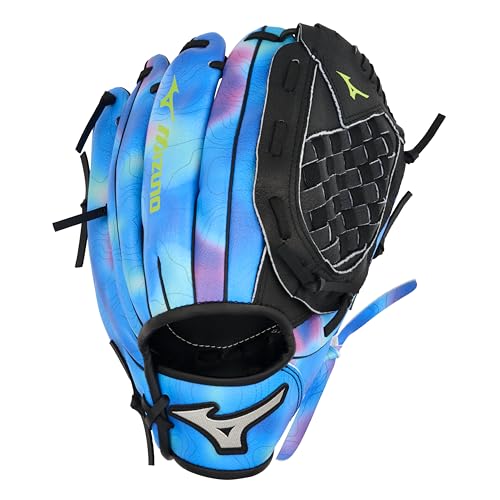 Mizuno Prospect PowerClose 11" Baseball GloveThe easy-closing 11-inch youth glove that fits most 8 to 10 year olds.~$55 · View on Amazon →
 Rawlings Sure Catch 11.5" Youth Baseball GloveAn 11.5-inch youth glove for 9 to 12 year olds at any position.~$48 · View on Amazon →
FAQ
What size baseball glove does a 10-year-old need?
Typically 10.5 to 11.5 inches, with 11 to 11.5 inches fitting most 10-year-olds. If they play a set position: 11 to 11.5 for middle infield, closer to 11.75 to 12.25 for outfield. The must-pass test: the player can fully close the glove with the glove hand alone.
What size glove does an 8-year-old need?
Usually 10.5 to 11 inches. Smaller or newer players do well at 10.5 inches with an easy-close design; bigger or more experienced 8-year-olds can use 11 inches. Position sizing does not matter yet.
What size glove does a 12-year-old need?
Usually 11.25 to 12 inches: about 11.25 to 11.5 for middle infielders, 11.5 to 11.75 for pitchers and third basemen, and 12 inches or a bit more for outfielders. First basemen and catchers use mitts with their own sizing.
How are baseball gloves measured?
Field gloves are measured in inches from the tip of the index finger, down through the pocket, to the center of the heel, using a flexible tape. Catcher's mitts are the exception: they are measured around the perimeter, which is why their numbers (about 30 to 34 inches) look so different.
What does RHT mean on a glove?
Right Hand Throw: the player throws with the right hand, so the glove is worn on the LEFT hand. It describes the throwing hand, not the hand the glove goes on, which is why it is the most common ordering mistake.
Should I buy a bigger glove for my kid to grow into?
No. An oversized glove flops open, will not close on the ball, and teaches drops. Buy the size that fits this season (one step up at most) and expect to size up as they grow. Youth gloves are priced for exactly that cycle.
What glove web is best for each position?
Open, light webs (I-web) for middle infielders who transfer fast; stronger H-webs for third base and outfield; deep trapeze webs for outfield fly balls; closed baskets for pitchers (hides the grip). First base and catcher use entirely different mitt designs. Below about 10U, web choice matters far less than an easy close.
How much should I spend on a youth baseball glove?
The sweet spot for ages 9 to 12 is roughly $45 to $90: real oiled leather that breaks in within days and survives 2 to 4 seasons. Go cheaper ($25 to $40) for ages 5 to 8 who will outgrow anything, and save premium steerhide ($120+) for 14+ when hands stop growing.
Are softball gloves sized differently than baseball gloves?
Yes. Fastpitch gloves run roughly an inch larger with deeper pockets for the bigger ball (11 to 12 inch softballs), plus narrower hand openings on fastpitch-specific patterns. Typical fastpitch fielder sizes: about 11.5 to 12.5 inches infield, 12.5 to 13 outfield for older players.
What size glove does a high school player need?
Adult sizes by position: about 11.25 to 11.75 inches for middle infielders, 11.5 to 12 for third base and pitchers, and 12.25 to 12.75 for outfielders. First basemen use roughly 12 to 13 inch mitts and catchers 32.5 to 34.5 inch mitts.
What size glove does a 5 or 6 year old need?
About 9.5 to 10 inches for most 5 and 6 year olds, in a soft, easy-close tee-ball or youth pattern. At this age the only test that matters is whether the child can squeeze the glove shut with the glove hand; position and web type do not matter yet.
Do outfielders need a bigger glove than infielders?
Yes. Outfield gloves run about half an inch to an inch longer with deeper pockets for reach on fly balls, while middle infielders use smaller, shallower gloves for quick transfers. Below about age 10 one all-around glove is the better buy.
Is an 11.5 inch glove too big for a 9-year-old?
Often, yes. Most 9-year-olds do best in 10.75 to 11 inches. An 11.5 can work for a bigger 9-year-old with strong hands, but only if the player can squeeze it fully shut with the glove hand alone.
We're the team behind MAVTRAX, a free pitch-calling app. This is a research guide: picks are chosen on manufacturer specs, league rules, build quality and real-world price, checked against live listings, not on who pays the highest commission. We haven't hands-on tested every product. Full criteria on how we pick.
Gloves we recommend
Top picks from our full guide. Live price on Amazon.


